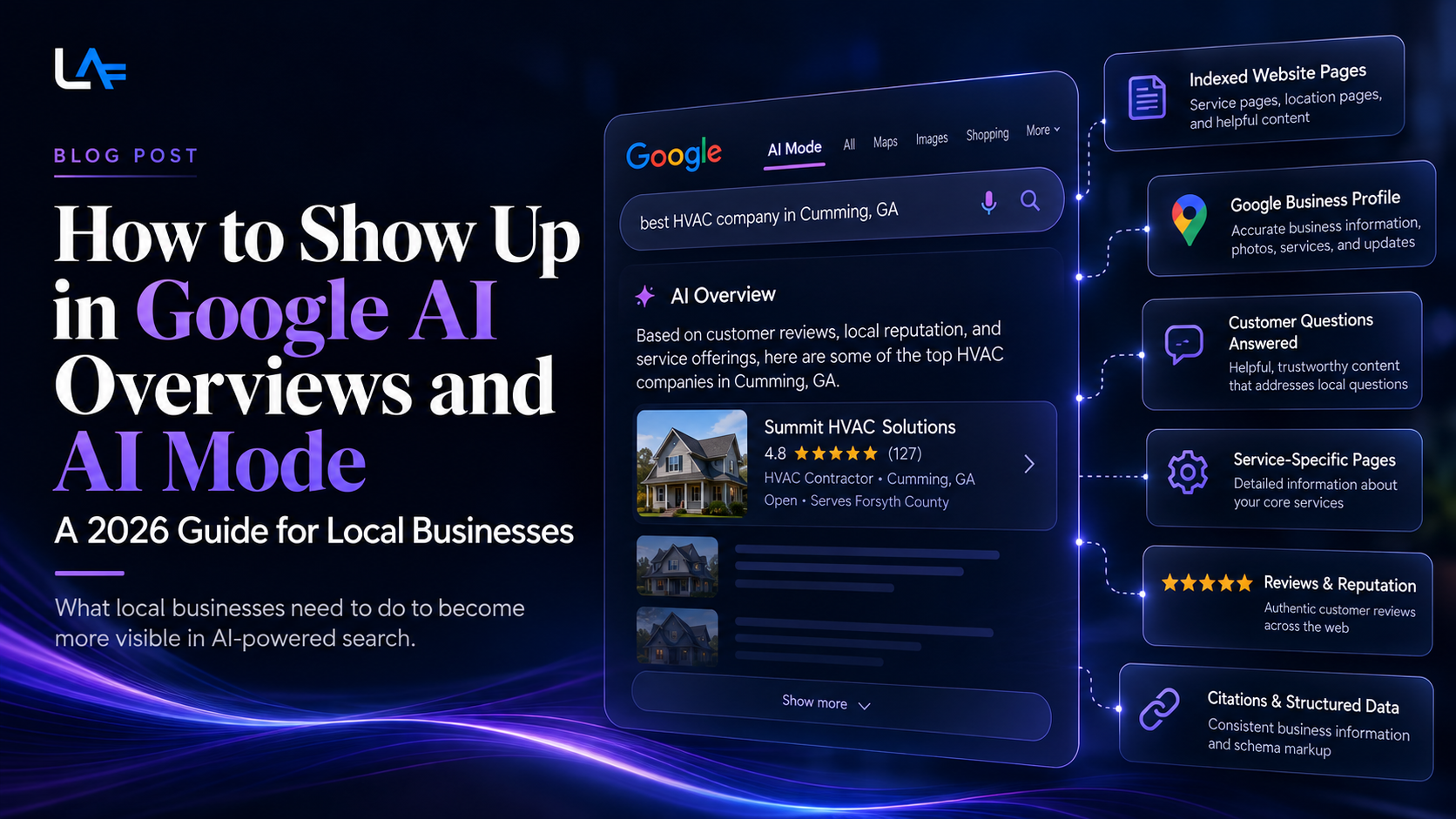
Google Search is changing how customers discover local businesses. Instead of simply presenting a list of websites, Google can now generate answers that summarize information and link to relevant sources. For local businesses, that creates an important opportunity: your company may become part of the information a customer sees before deciding whom to contact. But how do you get your business into Google AI Overviews and AI Mode?
The answer begins with strong search fundamentals, accurate business information, and content that genuinely helps customers make decisions.
What Are Google AI Overviews?
Google AI Overviews are AI-generated summaries that appear in certain Google Search results. They can combine information from multiple sources and provide links to supporting websites. For example, someone searching for the best way to replace an aging HVAC system might receive an AI-generated explanation of equipment options, efficiency considerations, and questions to ask contractors.
Google AI Mode offers a more conversational experience, allowing people to ask detailed questions and follow up as they research a topic.
For local businesses, the opportunity is to make their websites useful, discoverable sources of information and to become relevant options when customers research local services.
Can Local Businesses Appear in Google AI Overviews?
Yes. Eligible webpages from local businesses can appear as supporting sources in Google's AI-powered Search experiences. However, appearing as a source is different from being recommended as a provider. An HVAC company's website might be cited in an explanation about heat pumps without the company being recommended for installation. Similarly, a roofing contractor might be mentioned in a business comparison without receiving a direct endorsement.
Understanding those differences is essential when measuring AI visibility.
1. Make Sure Google Can Find Your Website
Before optimizing for AI-powered search, confirm that your most important pages are accessible to Google. Review your website in Google Search Console. Check that important pages are indexed, eligible to appear in Search, and not accidentally blocked by technical restrictions. Prioritize your homepage, primary service pages, location information, and important educational resources. A plumbing company should make sure Google can discover its water heater installation page.
A cosmetic dental practice should verify that its veneers and provider information is accessible.
If Google cannot access important content, that content cannot be selected as a supporting source in its search results.
Technical eligibility does not guarantee inclusion, but it establishes the foundation.
2. Answer the Questions Your Customers Actually Ask
Traditional keyword targeting remains useful, but customers increasingly search using detailed questions. A homeowner in Cumming, Georgia, might ask:
"How do I know whether I need a new roof or just repairs?"
Someone in Alpharetta might ask:
"What should I look for when choosing a cosmetic dentist for veneers?"
A customer in Johns Creek might ask:
"Should I replace my old water heater with a tankless system?"
Your website should provide useful, accurate answers to questions like these. Start with a clear explanation, then provide the detail necessary to help someone understand the decision. Avoid writing generic content that repeats information already available on hundreds of websites.
3. Create Strong Service-Specific Pages
Many local businesses rely on broad service descriptions. For example:
"We provide professional heating and cooling services throughout North Atlanta."
That statement identifies the business category but offers little detail. A stronger HVAC installation page could explain the company's actual services, assessment process, equipment options, and qualifications. A roofing contractor could describe its roof replacement process and the materials it installs. An electrician could explain what homeowners should expect when requesting a Level 2 EV charger installation.
These pages should address real services and customer questions. They should not be created solely to repeat keywords.
4. Maintain an Accurate Google Business Profile
Google Business Profile is an important source of local business information. Keep your business name, contact information, operating hours, website, location, and services accurate. If your company travels to customers, follow Google's requirements for service-area businesses. Do not create fictional offices in nearby cities. For example, a roofing contractor based in Cumming may legitimately serve Alpharetta and Johns Creek without maintaining physical offices in those communities.
Its website and business profile should accurately communicate that relationship. Accurate information helps customers understand where your business operates. It does not guarantee an AI recommendation.
5. Demonstrate Real Experience and Expertise
Local businesses have valuable information that generic websites cannot easily reproduce. A roofing contractor can document genuine completed projects. An HVAC company can explain its actual installation process. A dental practice can publish professionally reviewed treatment information. An attorney can explain legitimate practice areas and maintain accurate professional biographies. These resources help customers evaluate the business.
Original information can also provide useful material for search systems to discover. Avoid invented testimonials, fabricated projects, and unsupported claims of expertise.
6. Make Your Website Easy to Navigate
Important pages should be connected through useful internal links. A visitor reading about heat-pump installation should be able to find the company's installation services and contact information. Someone researching roof replacement should be able to navigate to relevant service pages. A cosmetic dentistry article should connect naturally to the appropriate treatment and provider information. A clear website structure helps customers discover related information.
It also supports ordinary search crawling and indexing.
7. Use Structured Data Accurately
Structured data helps search engines interpret information about webpages and businesses. Appropriate Organization or LocalBusiness markup can describe legitimate business information. However, structured data should match what appears on the website. Do not invent ratings, office locations, professional qualifications, or customer reviews. Google does not require special AI-specific schema markup to appear in AI Overviews or AI Mode.
Structured data supports accurate information. It is not a guaranteed shortcut into AI-generated answers.
8. Build Legitimate Local Authority
Your website is not the only place customers may encounter information about your company. Relevant professional directories, industry associations, local publications, and community organizations can provide additional information. Maintain accurate profiles where appropriate. Look for legitimate opportunities to contribute expertise or useful information. For example, a real estate agent might publish original local market research.
A contractor might contribute educational information to a community resource. The objective is to establish genuine public credibility rather than manufacture endorsements.
9. Measure AI Visibility Separately From Traditional Rankings
Traditional SEO reports measure search rankings, impressions, website traffic, and conversions. AI visibility requires additional evaluation. A business should distinguish between:
- Recommendations: The company is presented as a provider to consider.
- Mentions: The company is named in an AI-generated answer.
- Citations: The company's website is linked as a supporting source.
These outcomes can overlap but are not interchangeable. A business might receive citations without being recommended. Likewise, a company might appear in a recommendation without receiving a direct website citation.
10. Compare the Businesses Appearing Instead of Yours
Suppose an HVAC company serving Forsyth County rarely appears in AI-generated recommendations for heat-pump installation. Several competing companies appear more frequently. The next step is to examine the publicly available information about those businesses.
- Do competitors have more detailed installation pages?
- Are their qualifications easier to verify?
- Do they provide genuine project examples?
- Are their business profiles accurate?
These comparisons can identify potential improvements. However, they do not prove exactly why Google's systems selected one business over another.
A Practical 30-Day Improvement Plan
Week 1: Review Technical Accessibility
Check Google Search Console, indexing, important service pages, and relevant technical restrictions.
Week 2: Correct Business Information
Review Google Business Profile, website contact details, service areas, and important professional profiles.
Week 3: Improve Your Most Valuable Content
Strengthen incomplete service pages, add genuine experience where appropriate, and improve internal linking.
Week 4: Measure and Prioritize
Review available Google Search performance information and evaluate relevant AI-generated answers. Document competing businesses and prioritize meaningful gaps. Thirty days can establish a stronger foundation, but it cannot guarantee inclusion in Google AI Overviews or new customer inquiries.
Frequently Asked Questions
How do I get my website into Google AI Overviews?
Make sure important pages are indexable, accessible, and useful. Publish accurate information that addresses genuine customer questions and follow Google's established Search guidelines.
Does ranking first on Google guarantee an AI Overview citation?
No. Traditional search rankings and AI-generated supporting links are different outcomes.
Does Google Business Profile help with AI search?
Accurate Business Profile information supports Google's local business ecosystem, but it does not guarantee an AI recommendation.
Do I need special schema markup for Google AI?
No. Google does not require special AI-specific schema markup for AI Overviews or AI Mode.
Can a business outside Cumming appear in Cumming recommendations?
A company that genuinely serves Cumming may be relevant to local searches, but inclusion is not guaranteed.
How long does AI search optimization take?
There is no universal timeline. Indexing, content relevance, competition, and platform behavior can affect results.
What is the difference between being cited and being recommended?
A citation identifies an information source. A recommendation presents a business as a provider to consider.
Find Out Whether Google AI Recommends Your Business
Your company may have an established reputation, strong customer reviews, and a well-designed website. But do you know whether Google AI includes your business when potential customers research services in your market? The LocalAnswers AI Visibility Audit helps identify where your company appears, which competitors are receiving attention, and what information gaps deserve priority. We examine commercially relevant customer questions, business information, website accessibility, and competing recommendations.
The findings become a prioritized improvement roadmap.
Discover whether AI recommends your business and what to improve first.
Request Your LocalAnswers AI Visibility AuditBecome the business AI recommends.