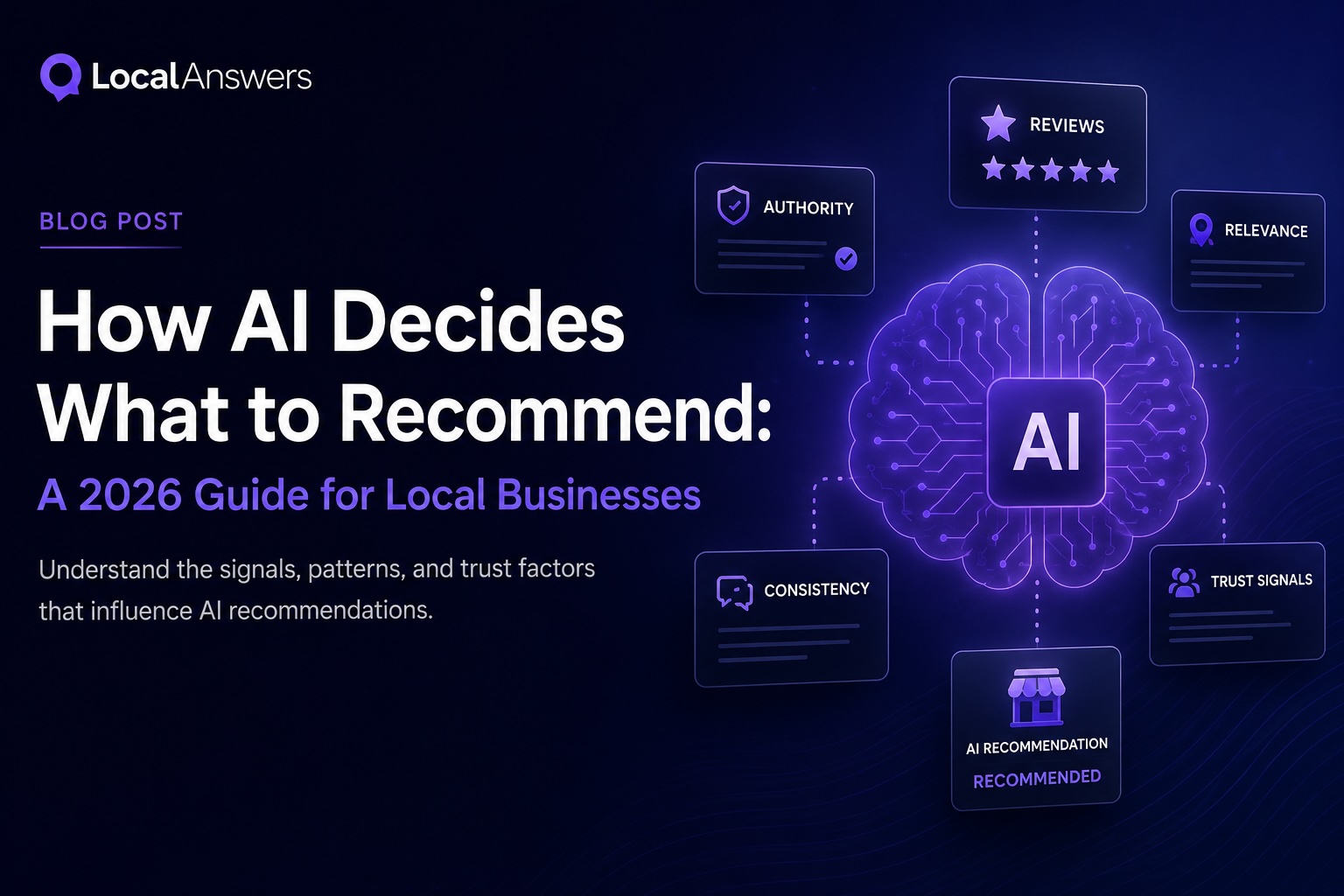
Someone near you opened ChatGPT, typed "best chiropractor in Cumming, GA," and got three names back. One of them was your competitor. None of them was you.
This is not a fringe scenario. Research from Pew Research Center published in July 2025 found that when Google AI Overviews appear in search results, users click traditional organic results only 8% of the time — down from 15% when no AI Overview is present. Seer Interactive analyzed over 3,000 queries and found click-through rates drop 61% when AI steps in to answer the question itself.
The customers who used to scroll down to your website are now reading an AI response that either names you or doesn't. And the businesses being named are not the most expensive, the largest, or the ones who've been around the longest. They're the most verifiable — and that's a distinction that can be closed.
This guide covers exactly how AI decides what to recommend, why high-rated businesses are still invisible, and what you can do about it. We'll draw on our own primary research across four Forsyth County categories and verified third-party data — no industry-blog statistics that can't be sourced.
AI Recommendations Are Not the Same as Google Rankings
The most expensive mistake a local business can make right now is assuming that ranking well in Google automatically means showing up in AI search. It doesn't.
Traditional SEO earns you a position in a list of ten blue links. AI visibility earns you a mention in a conversational response that most users never scroll past. These are two different outputs, built by two different systems, rewarding two different inputs.
A business can rank on page one of Google and be completely invisible in ChatGPT, Gemini, and Perplexity. We see this regularly in our Forsyth County research: some of the highest-ranking local search results for "best dentist near me" receive zero AI mentions across dozens of prompts. Conversely, some businesses with modest Google rankings show up consistently in AI responses because they've built exactly the kind of entity clarity that AI systems reward.
The practice of optimizing for AI recommendation systems is called Generative Engine Optimization, or GEO. It overlaps with SEO in some areas — both value authoritative content and consistent business information — but diverges in important ways. Understanding where they diverge is where the opportunity is.
| Factor | Traditional SEO | GEO / AI Visibility |
|---|---|---|
| Goal | Rank in a list of links | Be named in an AI response |
| Success metric | Position and CTR | Mention frequency and accuracy |
| Primary signal | Backlinks and on-page keywords | Entity clarity and citation consistency |
| Review impact | High (stars and volume) | Moderate (threshold, not differentiator) |
| Content type rewarded | Keyword-dense pages | Clear, structured, service-specific pages |
| Local signal | Google Business Profile | GBP + Yelp + Apple Maps + broad citation network |
| Geographic scope | Defined by proximity radius | Defined by how clearly your location is stated |
How Each AI Platform Decides What to Recommend
ChatGPT, Gemini, Perplexity, and Claude each have distinct architectures for answering local recommendation questions. Understanding the difference matters because optimizing for one doesn't guarantee visibility on all four — and the businesses that show up consistently across all platforms are the ones that have built broad, multi-source digital authority.
Combines a large language model trained on web data (including review sites, directories, and business websites) with optional live web search. For local queries, ChatGPT often relies on what it "learned" during training supplemented by real-time search. BrightLocal's 2024 study of 800 local searches found ChatGPT cited business websites as its source 58% of the time — making your own website the single highest-leverage asset for ChatGPT visibility.
Draws primarily from Google's own entity data — your Google Business Profile, Google Maps presence, structured data on your website, and the overall knowledge graph Google has built about your business. Gemini is the platform most directly tied to Google's traditional signals, which means strong GBP optimization and schema markup carry more weight here than anywhere else.
Runs live web searches for every query, then synthesizes results. It cites sources visibly in every response. BrightLocal found that Yelp appeared in 33% of all AI search queries studied, and Perplexity used Yelp in searches across every single industry category tested. If you don't have a Yelp listing, Perplexity has a harder time recommending you. This is the most actionable single platform-specific finding in this space.
Trained on a broad corpus of web data and generally more cautious about making specific local recommendations, particularly in categories where it lacks confidence. Businesses with detailed, well-structured website content and third-party mentions tend to appear more reliably. In our own Forsyth County research studies, Claude's recommendations were the most consistent with what a well-informed local resident would suggest — reflecting the weight it places on narrative mentions rather than raw listing data.
The research verdict is clear: no single platform should be your only focus. The businesses that consistently appear across all four are the ones that have made themselves easy to find and verify from multiple independent sources — a strategy that happens to improve your traditional SEO presence at the same time.
The 6 Signals That Determine AI Visibility
Across four primary research studies covering roofing, chiropractic, cosmetic dental, and med spa categories in Forsyth County, the same factors separated the recommended businesses from the invisible ones. Here they are in order of impact.
-
Google Business Profile completeness A claimed, verified, fully-completed GBP is the single most load-bearing asset for local AI visibility. Not just the basics — hours and address — but service-specific categories, treatment descriptions, photos, and a keyword-rich business description that explicitly states your specialty. AI systems use GBP data to classify what kind of business you are before evaluating whether you're the right answer to a specific query.
-
Citation consistency across directories Your business name, address, and phone number (NAP) must match exactly across Google Business, Yelp, Apple Maps, Bing Places, and the major industry directories relevant to your category. Inconsistency — a different suite number here, an old phone number there — creates ambiguity that AI systems resolve by reducing their confidence in you. We've seen businesses with 300+ reviews get filtered out of AI recommendations because their listings had conflicting data.
-
Website content specificity A website that says "we offer a variety of services" is invisible to AI. A website with dedicated pages for each specific service — "Botox in Cumming, GA," "roof replacement Forsyth County" — gives AI systems a concrete, matchable answer to a specific query. The question AI is trying to answer is not "is this a good business?" but "is this the right business for this specific question?" Service specificity is how you become the right answer.
-
Category positioning clarity AI systems categorize businesses before they evaluate them. A clinical dermatology practice and a dedicated med spa can offer identical injectable treatments, but if the dermatology practice brands itself primarily around skin conditions and the med spa brands itself around aesthetics and injectables, the med spa will dominate AI recommendations for "med spa" queries. This pattern appeared in every category we studied. Being clearly positioned as a specialist in a specific category matters more than being a generalist with a broader offering.
-
Third-party mentions and citations AI systems treat independent validation the way a journalist treats a corroborated source. Local news coverage, chamber of commerce listings, community directories, industry associations, and local sponsorships all contribute to the picture AI builds of your business as a legitimate, embedded local entity. These mentions don't need to be high-authority backlinks in the SEO sense — their value is in confirming that you exist and are recognized by parties outside your own website.
-
Structured data markup on your website Schema markup — specifically
LocalBusiness,Service, andFAQPageschemas — tells AI systems exactly what you do, where you do it, and for whom, in a machine-readable format. Only approximately 12% of websites use any schema markup at all, which means this is both underused and meaningfully impactful for businesses that implement it correctly.
The Counterintuitive Truth About Reviews and AI Visibility
This is the finding that surprises every business owner we share it with, and it's the most important thing to understand if you're trying to improve your AI visibility: review ratings and review volume do not reliably predict which businesses AI recommends.
Across our research in Forsyth County, we compared the Google ratings of businesses that received AI recommendations against businesses that received none. The difference was negligible:
Read that last stat again. The businesses with more reviews were the ones AI was less likely to recommend. In the med spa category specifically, Atlanta Center For Dermatologic Diseases (4.9 stars, 1,170 reviews) and Cleaver Dermatology and Aesthetics (4.8 stars, 1,158 reviews) received zero AI mentions across 32 platform-prompt combinations. Meanwhile, practices with far fewer reviews dominated every platform.
What explains this? Category positioning. Both of those practices brand themselves primarily as dermatology offices — and AI systems, when asked about med spas, appear to filter by business category before reputation signals enter the calculation at all. Reviews confirm quality within a category. They don't move you into a different category.
If you are a dentist, med spa, chiropractor, or roofing contractor with a strong review profile who is not appearing in AI recommendations, the problem is almost certainly not your rating. It is how your business is positioned — specifically, whether AI systems classify you as the right kind of business before they ever evaluate whether you're a good one. More reviews will not fix a positioning gap.
This does not mean reviews don't matter. A rating below approximately 4.5 effectively disqualifies a business from AI recommendations in most categories. But climbing from 4.8 to 5.0, or accumulating hundreds of additional reviews, does nothing for AI visibility once that threshold is cleared. If you've been pouring energy into review acquisition hoping it would move the needle on AI — it won't. The work is elsewhere.
How to Show Up in Google AI Overviews (and AI Search Broadly)
Google AI Overviews now appear in a substantial portion of local and informational queries, and the CTR impact is measurable: organic click rates drop significantly when an AI Overview answers the question before users reach traditional results. Getting into the AI Overview — or any AI recommendation — requires the same underlying work, applied deliberately.
Here's the framework we use for the businesses we work with in Forsyth County:
-
Audit your current AI visibility first Before optimizing, know where you stand. Run your own business category through ChatGPT, Gemini, Perplexity, and Claude with 5–8 prompts. Try both general queries ("best chiropractor in Cumming GA") and treatment-specific ones ("chiropractor for lower back pain in Forsyth County"). Record who appears, how often, and what language is used. This is your baseline. If you want this done systematically with competitor benchmarking, our AI Visibility Audit covers all four platforms across dozens of prompts.
-
Complete and optimize your Google Business Profile This is the single highest-impact action for Gemini and AI Overviews specifically. Verify the listing, add all relevant service categories, write a business description that explicitly states your specialty (not just your name), upload current photos, and set hours accurately. Add a services section with individual entries for each major treatment or service you provide, using the language patients and customers actually use, not clinical or technical jargon.
-
Build a clean citation network Claim and verify listings on Yelp (critical for Perplexity), Apple Maps via Business Connect, and Bing Places. Then audit your existing listings for NAP consistency — every location where your business name, address, or phone appears differently is a trust signal that works against you. Tools like BrightLocal or Whitespark can surface these inconsistencies. Fix the mismatches before building new listings.
-
Create service-specific pages on your website If your website has a single "Services" page listing everything you do, you are structurally at a disadvantage. Create individual pages for each major service, each targeting the language people use when searching for that specific treatment or service. A cosmetic dentist should have a page specifically for teeth whitening, a page for veneers, a page for Invisalign — not one page that mentions all three. Each page gives AI systems a specific, indexable answer to a specific treatment query.
-
Add schema markup to your website Implement
LocalBusinessschema on your homepage with your full address, phone, hours, and service area. AddServiceschema to each service page. AddFAQPageschema to any page with a question-and-answer section. If you have named staff, addPersonschema for key practitioners. This gives AI systems a structured, machine-readable version of the information they'd otherwise have to infer from your content. -
Build local third-party mentions deliberately Join your local chamber of commerce (the Cumming-Forsyth Chamber of Commerce directory is a direct citation for local businesses). Sponsor local events, youth sports, or community organizations that publish a list of sponsors online. Pursue press mentions from local outlets. Submit to industry-specific directories relevant to your category. Each independent source that mentions your business name consistently with your address and phone number adds to the verification footprint that AI systems use to build confidence in recommending you.
Want to know exactly where your gaps are?
Our AI Visibility Audit benchmarks your business across ChatGPT, Gemini, Claude, and Perplexity — with a full competitor comparison and a 90-day roadmap. Delivered in 24–48 hours.
Get Your AI Visibility AuditWhat Generative Engine Optimization Actually Involves
Generative Engine Optimization — GEO — is the systematic practice of making your business easier for AI systems to understand, trust, and recommend. It is not a trick, a shortcut, or a one-time fix. It is a set of deliberate, structural changes to how your business presents itself across the web, done in the right order for maximum compounding effect.
GEO is not a replacement for SEO. The best outcomes we've seen come from businesses that address both simultaneously, because many of the same actions — clean citations, structured website content, strong GBP — improve both traditional search rankings and AI recommendation frequency at the same time.
What GEO adds on top of traditional SEO:
- Platform-specific citation strategy — knowing that Perplexity weights Yelp, that Gemini weights GBP, and that ChatGPT weights your website, and addressing each deliberately
- Category positioning analysis — ensuring AI systems classify your business correctly before evaluating it for any specific query
- Prompt-based testing — using the actual prompts customers type into AI assistants to test whether your business appears, rather than relying on rank tracking tools that don't capture AI outputs
- Schema depth — implementing structured data beyond the basics that most SEO efforts address
- Entity coherence audit — confirming that every public source of information about your business tells the same story
We've published four category-specific research reports that show exactly how AI visibility plays out in real local markets: roofing, chiropractic, cosmetic dentistry, and med spa. If your industry is covered, reading the relevant report will show you who AI is currently recommending in Forsyth County — and how far the gap is between them and the rest of the market.
How Long Does It Take to Show Up in AI Recommendations?
This depends on where you're starting from, but we can offer reasonable benchmarks based on what we observe working with local businesses:
60–90 days for businesses with a solid foundation — verified GBP, consistent major citations, strong reviews — who are primarily addressing content gaps and schema. The low-hanging fruit (GBP optimization, Yelp claim, schema implementation) often produces measurable improvement in this window because the competition hasn't done this work either.
90–180 days for businesses starting with citation errors, thin website content, or missing major directory listings. Correcting inconsistent NAP data takes time because it requires updating dozens of sources and waiting for AI training cycles to reflect the changes.
Ongoing for maintaining visibility as competitors begin their own GEO work. AI recommendations are not a one-time achievement. They reflect the current state of your digital presence relative to the current state of your competitors' digital presence, and both continue to evolve.
The businesses that win AI recommendation share are not the ones that do everything at once. They're the ones that identify the highest-leverage gaps in their specific market, address those gaps first, and monitor consistently. If you're not sure what your highest-leverage gaps are, that's the right starting question — and the right place to start is understanding why you're not showing up before deciding how to fix it.
Frequently Asked Questions
How does Google AI Overviews decide which businesses to recommend?
Google AI Overviews pulls from Google's Knowledge Graph, your Google Business Profile, structured data on your website, and the overall entity footprint Google has built about your business over time. Businesses with complete GBP listings, consistent NAP data across directories, and clear on-page service descriptions are significantly more likely to be surfaced. Unlike traditional organic rankings, AI Overviews favor entity clarity over keyword density.
How do I get my business recommended by ChatGPT?
ChatGPT draws on training data — which includes review platforms, directories, local news, and your website — and in some cases live web search. To show up in ChatGPT recommendations: ensure your business has a well-optimized Google Business Profile, maintain consistent Name, Address, and Phone across all directories, earn reviews that mention specific services by name, build third-party mentions through local press and citations, and make your website's service pages specific and clearly structured. BrightLocal's research found that ChatGPT cites business websites 58% of the time — making your own site the single highest-leverage asset.
Does having more Google reviews help with AI visibility?
Not in the way most businesses expect. In our Forsyth County research across four categories, businesses that received AI recommendations and businesses that received none had nearly identical average star ratings (4.88 vs 4.87). Non-recommended practices actually had a higher median review count. Reviews function as a minimum threshold — you need a strong rating to be considered — but accumulating more reviews above that threshold does not reliably increase AI recommendation frequency.
What is generative engine optimization (GEO)?
Generative Engine Optimization (GEO) is the practice of optimizing your business's digital presence so that AI systems like ChatGPT, Google Gemini, Claude, and Perplexity are more likely to recommend you in their responses. Unlike traditional SEO, which focuses on ranking in a list of links, GEO focuses on becoming the answer AI gives when someone asks a conversational question about your service category. Learn more about what GEO is and how it compares to traditional SEO.
How long does it take to show up in AI recommendations?
Businesses with a solid existing foundation — verified GBP, consistent citations, strong reviews — typically see measurable improvement within 60 to 90 days of targeted GEO work. Businesses with significant citation errors or thin website content typically require 90 to 180 days. The most important factor is identifying and addressing your highest-leverage gaps first, rather than trying to do everything at once.
What is the difference between SEO and GEO?
Traditional SEO optimizes for ranking in a list of links on a search results page. GEO optimizes for being named in a conversational AI response. SEO success is measured by position and click-through rate. GEO success is measured by whether AI recommends you when someone asks about your service. The two strategies overlap — both value authoritative content and consistent business information — but GEO places much more weight on entity clarity, category positioning, and citation breadth across the platforms AI systems actually use as sources.
Which AI platforms should I focus on for local business visibility?
All four: ChatGPT, Gemini, Perplexity, and Claude. Research from BrightLocal found that the sources each platform uses differ meaningfully — Perplexity uses Yelp heavily, Gemini leans on Google's entity data, and ChatGPT weights business website authority. Businesses that appear consistently across all four platforms have built broad citation and content coverage, not platform-specific optimization. The good news is that the foundational work — GBP, citations, website content, schema — improves your standing on all four simultaneously.
Why does my competitor show up in AI search but I don't?
The most common reasons a competitor is recommended while you are not: they have a more complete GBP with service-specific categories, their website clearly positions them as a specialist while yours is more general, they have more consistent citations across directories, or they have third-party mentions that give AI systems independent validation. In most cases, the recommended business is not better at their craft — they are simply more clearly defined in their digital presence. That gap is fixable.