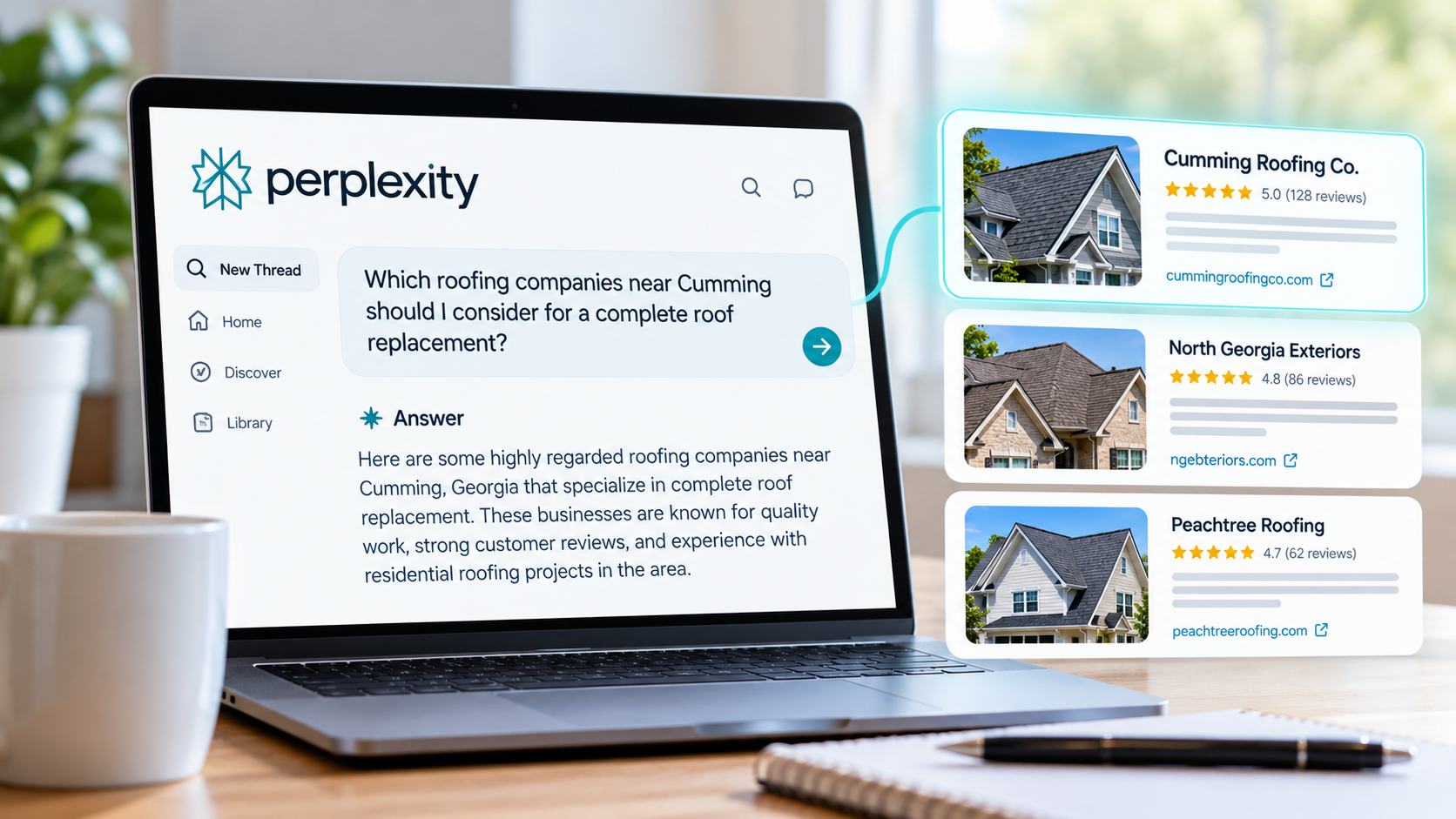
Imagine a homeowner in Cumming, Georgia, searching for a roofing contractor. Instead of opening Google and scrolling through dozens of websites, they ask Perplexity AI:
"Which roofing companies in Forsyth County should I consider for a complete roof replacement?"
Perplexity searches for relevant information, identifies businesses, summarizes what it finds, and provides links to supporting sources. The homeowner reviews those recommendations and decides which contractors to contact. But what happens if your roofing company never appears? You may have excellent customer reviews, years of experience, and a professional website. Yet Perplexity may identify competing businesses instead.
That's why Perplexity AI visibility is becoming an important consideration for local businesses. Customers can use AI-powered answer engines to research companies, compare services, and make purchasing decisions before visiting a business's website. The opportunity isn't simply to rank for another keyword. It's to make your business discoverable, credible, and relevant when prospective customers ask AI whom they should hire.
What Is Perplexity AI?
Perplexity is an AI-powered answer engine that combines conversational responses with web search and source citations. Instead of presenting only a list of search results, Perplexity can gather information from webpages, summarize relevant findings, and provide links to supporting sources. For local businesses, that creates two important opportunities:
- Business recommendations: Perplexity may identify your company when someone asks for providers in your industry or geographic market.
- Source citations: Perplexity may reference your website when answering questions about services, products, or industry topics.
These outcomes are related but different. A roofing company's educational article might be cited in an explanation about roof replacement without the company being recommended as a contractor. Likewise, Perplexity may recommend a business without citing its official website. A successful AI visibility strategy should evaluate both outcomes.
How Do You Get Your Business Recommended by Perplexity?
To improve your business's visibility in Perplexity AI, make your website accessible, clearly describe your services and geographic coverage, publish accurate and useful information, maintain legitimate public business profiles, and measure whether Perplexity independently recommends your company.
There is no guaranteed placement formula. Perplexity does not publish a universal rule stating that a business needs a particular number of reviews, citations, backlinks, or articles to receive recommendations. Instead, businesses should focus on information they can verify and improve. That begins with understanding how customers search.
1. Understand What Your Customers Are Asking Perplexity
Traditional search queries are often short. Someone might search Google for:
"HVAC Cumming GA"
But in Perplexity, the same customer could ask:
"Which HVAC companies in Cumming, Georgia, specialize in replacing older residential heating and cooling systems?"
That question contains more information about the customer's needs. They aren't simply looking for any HVAC contractor. They're researching a specific service. This distinction matters because businesses should evaluate AI visibility around the services they actually want to sell.
Examples of Local Business Searches
- Roofing: "Which roofing contractors in Forsyth County specialize in full roof replacements?"
- HVAC: "Who installs energy-efficient heat pumps near Alpharetta?"
- Cosmetic Dentistry: "Which cosmetic dentists near Johns Creek offer porcelain veneers consultations?"
- Med Spas: "Which med spas in North Atlanta offer injectable treatment consultations?"
- Chiropractic: "Which chiropractors in Cumming are accepting new patients?"
- Plumbing: "Who installs tankless water heaters in Forsyth County?"
- Electrical: "Which electricians near Alpharetta install residential EV charging stations?"
- Real Estate: "Which real estate agents specialize in selling homes in Cumming?"
Each question represents a different customer need. A company might be visible for general industry searches but absent from questions involving its most valuable services.
Your Perplexity visibility strategy should focus on the customer questions that create meaningful business opportunities.
2. Check Whether Perplexity Currently Recommends Your Business
Before changing your website, establish a baseline. Start by asking Perplexity questions that prospective customers might naturally use. Avoid including your company's name in the initial questions. For example, asking:
"Tell me about ABC Roofing."
tests whether Perplexity can identify a business you've already named. It does not establish whether the platform would independently recommend ABC Roofing. Instead, ask:
"Which roofing contractors should I consider for a roof replacement in Cumming, Georgia?"
Then document the answer. Record which companies appear, whether your business is included, and which sources Perplexity cites. Repeat the question under comparable conditions. AI-generated answers can vary, so one response should not be treated as a permanent ranking.
Measure Three Different Outcomes
- Recommendation Rate: The percentage of relevant observations in which Perplexity presents your business as a provider to consider.
- Mention Rate: The percentage of observations in which your business is named.
- Owned Citation Rate: The percentage of observations in which Perplexity cites your official website.
For example, if your business is recommended in 8 of 20 valid observations, its observed recommendation rate is 40%. That doesn't mean Perplexity recommends your company 40% of the time across every possible search. It describes the specific questions and conditions tested.
3. Make Sure Perplexity Can Access Your Website
A business can publish useful content and still experience technical problems that affect discovery. Perplexity documents two relevant web-access agents.
PerplexityBot
PerplexityBot supports website discovery for Perplexity search results. Website owners who want their public content available for search discovery should review whether their robots.txt and security configurations permit appropriate access.
Perplexity-User
Perplexity-User retrieves webpages in response to user requests. Perplexity explains that this user-directed retrieval operates differently from ordinary automated crawling. For businesses, the important consideration is whether relevant public information can be retrieved when needed. A roofing company should examine its roof replacement page. An HVAC contractor should review its installation services. A dental practice should verify that its provider biographies and procedure information are accessible.
Also check whether website security tools unintentionally block legitimate requests.
Allowing Perplexity to access a website does not guarantee citations or business recommendations. It removes one potential technical obstacle.
4. Clearly Explain the Services Your Business Provides
Many local business websites rely on generic marketing language. For example:
"We provide quality home services throughout North Atlanta."
That statement doesn't explain much about the company's actual capabilities. A stronger website identifies specific services and helps customers understand what to expect. Consider an HVAC company specializing in heat-pump installation. Its website could explain the equipment it installs, its assessment process, relevant installation considerations, and how customers request an estimate. A cosmetic dental practice might explain its veneer consultation process and identify the qualified providers responsible for treatment.
A plumbing contractor could explain how it evaluates homes for tankless water heater installation. These details help customers make informed decisions. They also provide more relevant information for search-backed AI systems to evaluate.
Use Clear, Answer-First Explanations
For example:
What should homeowners consider before installing a tankless water heater?
Homeowners should evaluate their household's hot-water demand, equipment capacity, fuel or electrical requirements, installation conditions, and applicable permits. A qualified plumbing professional can help determine which options are suitable for the property. That paragraph answers a genuine question directly. The supporting article can then explain the subject in more detail. This approach is useful to readers and makes the content easier to understand.
However, answer-first formatting does not guarantee Perplexity citations.
5. Publish Original Information Worth Referencing
One of the strongest opportunities for local businesses is publishing information based on real experience. Consider two roofing companies. The first has a short page stating:
"We offer professional roofing services. Call today."
The second provides detailed information about its actual roof replacement process, materials, and completed projects. The second website gives homeowners more specific information to evaluate. That doesn't guarantee an AI recommendation. But it provides genuinely useful content.
Document Real Projects
A roofing contractor could publish a case study about a completed roof replacement in Forsyth County. An electrician could document a residential EV charger installation. An HVAC company could explain the work performed during an actual system replacement. A real estate agent might publish original local market research using properly sourced data. These examples should be accurate.
Avoid inventing project results, certifications, testimonials, or performance improvements.
Publish Original Local Research
Businesses with access to meaningful industry information can also publish research. For example, LocalAnswers has studied AI recommendation visibility among roofing companies in Forsyth County. Research of this kind can provide useful information beyond generic AI SEO advice. A credible study should disclose the businesses evaluated, questions tested, platforms used, dates, and limitations.
Original information can create opportunities for citations, but no business should assume that publishing research guarantees inclusion in Perplexity's answers.
6. Keep Your Business Information Accurate Across the Web
Your website isn't the only source of information customers may encounter. Business profiles, professional directories, industry associations, and local publications may also describe your company. Review those sources for accuracy. Important information includes your official business name, website, telephone number, actual location, geographic service coverage, and current services. For regulated industries, professional credentials should also be accurate and verifiable.
Google Business Profile and Bing Places
Maintain legitimate profiles with correct business information. A contractor serving Alpharetta from a Cumming office should not claim a fictional Alpharetta location. A dental practice that moves offices should update important location references. A law firm should maintain current attorney biographies and affiliations. Accurate information helps prospective customers understand the business. However, Perplexity does not publish a universal rule establishing that Google Business Profile rankings determine its recommendations.
The practical approach is to maintain reliable public information and examine which sources Perplexity actually uses.
7. Make Your Geographic Coverage Clear
Location matters when customers ask AI for local businesses. Consider three questions:
"Which roofing companies are located in Cumming?"
"Which roofing companies serve Cumming?"
"Which roofing contractors are near Cumming?"
These questions are related but not identical. The first emphasizes physical location. The second emphasizes service availability. The third may include neighboring communities. A roofing contractor based in Cumming might legitimately serve Alpharetta, Johns Creek, and other parts of North Atlanta. Its website should explain that coverage accurately. But the business should not create fictional offices or duplicate city pages simply to appear more local.
Use Real Local Examples
A contractor that completed a genuine project in Alpharetta might publish a relevant project example. A dental practice could explain its actual office location and the communities from which it welcomes patients. A real estate agent might publish accurate neighborhood-specific market analysis. These resources should provide meaningful information rather than repeat the same content with different city names.
Local relevance should reflect actual operations and experience.
8. Build Legitimate Third-Party References
A business can control its own website, but independent sources may also help customers evaluate its credibility. Examples include professional associations, legitimate industry directories, manufacturer websites, and local publications. A contractor might maintain an accurate manufacturer profile. An attorney may have current professional directory information. A dental practice can maintain legitimate provider profiles. A local business might contribute original expertise to a regional publication.
These references should reflect genuine professional relationships and accurate information. Avoid purchasing fabricated endorsements or creating misleading profiles. There is no documented universal number of directory listings or mentions required for Perplexity recommendations.
9. Compare the Competitors Perplexity Recommends
Knowing that your business doesn't appear is useful. Knowing which competitors appear instead is more actionable. Suppose an HVAC company in Cumming tests questions about heat-pump installation. Several competing contractors appear repeatedly. The next step is to examine observable differences.
- Do those companies have more detailed installation pages?
- Are their professional qualifications clearly explained?
- Do they have documented projects?
- Are their business locations accurate?
- Which sources does Perplexity cite?
These questions can reveal information gaps worth investigating. However, observable differences do not prove that a particular factor caused Perplexity to recommend one company over another.
A credible competitive audit separates verified information from assumptions about proprietary AI ranking systems.
10. Measure Perplexity Visibility Over Time
AI-generated recommendations can change. For that reason, a business should establish a consistent measurement process. A practical starting point is to select 10–20 commercially relevant customer questions and test them repeatedly. Record the date, exact question, relevant geographic context, businesses recommended, and supporting citations. After making meaningful website or business-information improvements, repeat the benchmark. Compare the results.
Look for sustained patterns rather than reacting to one answer.
Connect Visibility to Business Outcomes
Where possible, review website analytics for identifiable Perplexity referrals. Also monitor qualified inquiries, consultation requests, estimate appointments, and completed sales. Keep in mind that some customers may research businesses through Perplexity and then contact them directly. Those interactions may not produce identifiable website referral traffic. A customer intake question such as "How did you hear about us?" can provide additional context.
AI recommendations, website visits, qualified leads, and revenue are different outcomes that should be measured separately.
A Practical 30-Day Perplexity Visibility Plan
Week 1: Establish Your Baseline
Identify the services your business wants to grow. Develop a consistent set of customer questions. Test Perplexity using nonbranded searches. Document recommendations, mentions, citations, and competitors.
Week 2: Review Technical Accessibility
Check your most important public webpages. Review PerplexityBot access. Investigate unintended security restrictions. Make sure relevant business information is accessible and readable.
Week 3: Improve Your Public Information
Strengthen incomplete service pages. Correct outdated business listings. Update legitimate professional credentials. Add useful original information based on actual experience. Connect related content through internal links.
Week 4: Recheck and Prioritize
Verify that important changes have been published. Repeat selected benchmark questions. Compare the observations. Identify the next improvements supported by the evidence. Thirty days can establish a stronger foundation for discovery. It does not guarantee Perplexity recommendations or additional customers.
Frequently Asked Questions
Can Perplexity recommend local businesses?
Yes. Perplexity can identify local businesses when users ask relevant questions. Its responses may include supporting citations that customers can inspect.
How do I get my business recommended by Perplexity?
Start by measuring current recommendations. Then review your website's accessibility, service information, legitimate credentials, geographic coverage, and public business profiles. There is no guaranteed placement formula.
How do I get my website cited by Perplexity?
Make relevant pages accessible and publish accurate, useful information. Perplexity recommends permitting appropriate search-crawler access, but citations are not guaranteed.
Does Perplexity use Google rankings?
Perplexity uses web search and retrieval to support answers. It does not publish a universal rule stating that traditional Google ranking positions determine its business recommendations.
Do Google reviews guarantee Perplexity recommendations?
No. Genuine reviews provide useful reputation information, but there is no published universal review threshold that guarantees inclusion.
Is Perplexity SEO different from traditional SEO?
Perplexity SEO focuses on visibility in AI-generated answers, citations, and recommendations. Traditional SEO remains an important foundation because accessible websites and useful content support broader search discovery.
Does schema markup guarantee Perplexity visibility?
No. Accurate structured data can support search understanding, but there is no universal schema configuration that guarantees Perplexity recommendations.
Can a business outside Cumming appear in Cumming recommendations?
Yes. A business that legitimately serves Cumming may be relevant to customer questions involving that market. Inclusion is not guaranteed, and the business should accurately represent its location and service area.
How often should I check Perplexity visibility?
Monthly monitoring of a consistent group of customer questions can provide a practical starting point. Businesses may also recheck after significant website or service changes.
Can Perplexity visibility generate more leads?
AI recommendations can create customer discovery opportunities. However, appearing in a response does not automatically generate an inquiry or sale.
Is an AI Visibility Audit worthwhile?
An audit can identify whether your business appears in relevant AI recommendations, which competitors appear instead, and what public information gaps deserve attention.
Your Business Should Be Discoverable When Customers Ask Perplexity
Local businesses spend years building their reputations. They serve customers, complete projects, develop professional expertise, and establish relationships within their communities. But those strengths aren't always communicated clearly online. A roofing contractor may have extensive installation experience without documenting completed projects. An HVAC company may specialize in system replacements but have only a generic service description.
A professional practice may have qualified providers whose credentials aren't easy to verify. These are opportunities for improvement. Perplexity visibility isn't about manufacturing credibility or publishing hundreds of repetitive articles. It's about making accurate, useful business information available when prospective customers research their options. And it's about measuring whether that information results in relevant recommendations and citations.
The goal isn't simply to get Perplexity to mention your company. It's to become a credible option when customers ask for the services your business actually provides.
Find Out Whether Perplexity Recommends Your Business
When someone asks Perplexity for businesses in your industry, does your company appear?
- Does it accurately describe your services?
- Does it cite your website or competing sources?
- Which local businesses does it recommend instead?
And how does your visibility compare with ChatGPT, Gemini, and Claude? The LocalAnswers AI Visibility Audit helps answer those questions. We evaluate commercially relevant customer questions across leading AI platforms, document recommendations and citations, identify competing businesses, and investigate meaningful gaps in publicly available information. That includes service content, website accessibility, geographic accuracy, professional credentials, reputation, and independent references.
The findings become a prioritized improvement roadmap. Instead of guessing whether your business needs more reviews, additional directory listings, new website pages, or technical changes, begin with evidence.
Get Your LocalAnswers AI Visibility Audit
Discover whether Perplexity and other AI platforms recommend your business, which competitors appear instead, and what you should improve first.
Request Your LocalAnswers AI Visibility Audit
Become the business AI recommends.