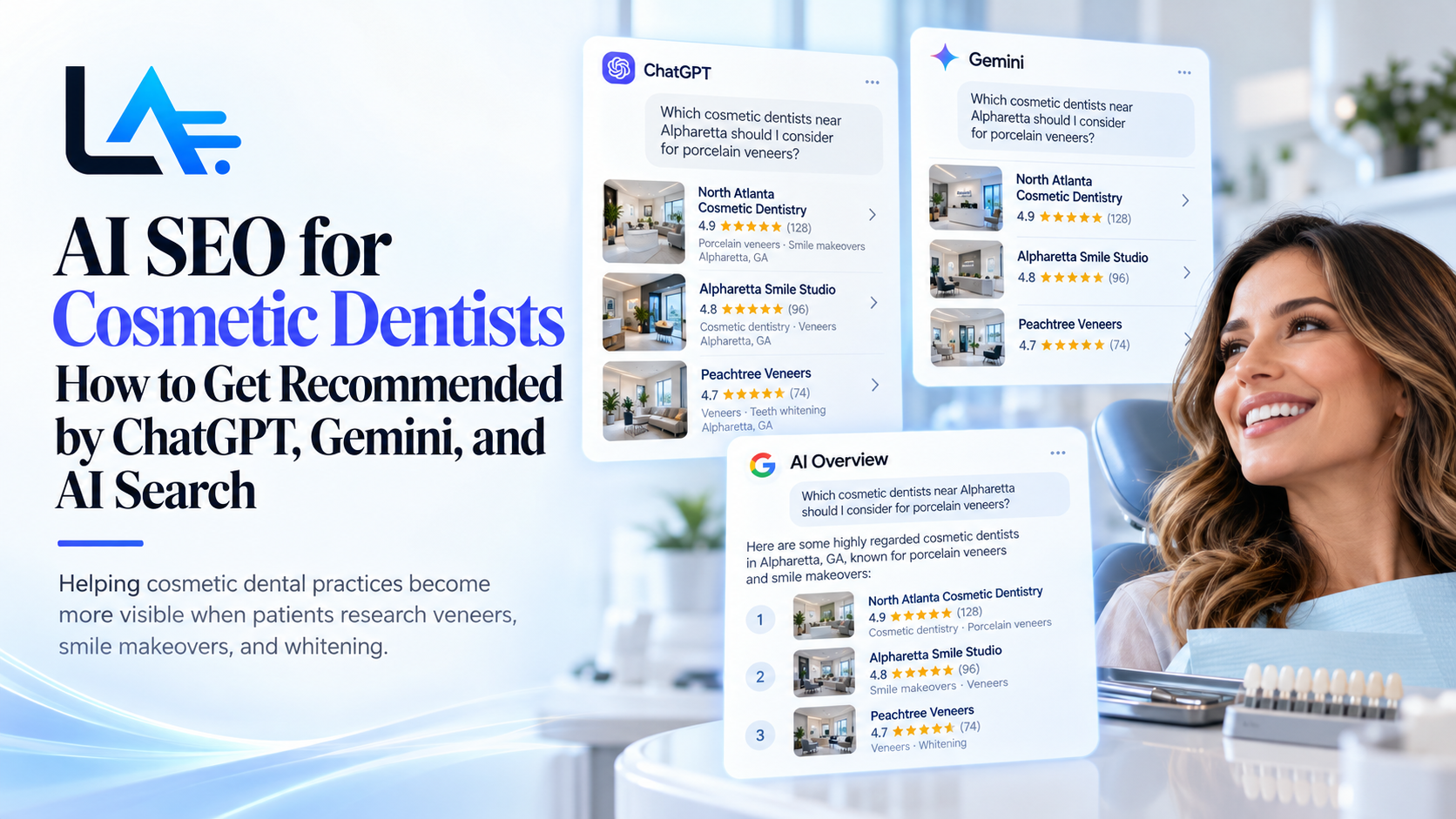
A patient in Alpharetta, Georgia, is thinking about improving their smile. They've been researching porcelain veneers, but they're not ready to schedule an appointment. First, they want to understand their options and find a dentist they can trust. They open ChatGPT and ask:
"Which cosmetic dentists near Alpharetta should I consider for porcelain veneers?"
Later, they ask Gemini:
"How do I compare cosmetic dentists for a smile makeover?"
Then they use Perplexity to research the practices they discovered. By the time they contact a dental office, they may already have a shortlist of providers. Now imagine your practice offers veneers, cosmetic consultations, and other restorative or aesthetic dental services. You have experienced dentists, an established reputation, and satisfied patients. But your practice never appears in those AI-generated recommendations.
That's the opportunity behind AI SEO for cosmetic dentists.
AI visibility is about whether your dental practice becomes a credible option when prospective patients ask AI assistants to help them research and compare providers.
It isn't about guaranteeing that ChatGPT will recommend your practice or manipulating AI systems with artificial reviews. It's about making accurate information about your services, providers, experience, and location easier to discover—and measuring whether your practice actually appears.
What Is AI SEO for Cosmetic Dentists?
AI SEO for cosmetic dentists is the process of improving how accurately and consistently a dental practice appears in AI-generated answers, recommendations, and source citations for cosmetic dentistry searches.
It combines traditional search engine optimization with Generative Engine Optimization (GEO), Answer Engine Optimization (AEO), and AI recommendation measurement. For a cosmetic dental practice, important questions might involve porcelain veneers, teeth whitening, dental bonding, or smile makeover consultations. A practice may appear in general dentist recommendations while rarely appearing when prospective patients ask about specific cosmetic services.
That distinction matters because the patient is looking for a particular type of care. AI SEO should therefore focus on genuine treatment capabilities and patient questions, not simply increasing the number of times the practice name appears online.
1. Measure Which Cosmetic Dentistry Searches Recommend Your Practice
Before investing in additional marketing, establish your current visibility. Start with nonbranded questions that prospective patients might actually ask. For example:
- "Which cosmetic dentists near Alpharetta offer porcelain veneers?"
- "What dental practices in Cumming provide smile makeover consultations?"
- "Which dentists near Johns Creek offer cosmetic bonding?"
- "How can I compare cosmetic dental practices in North Atlanta?"
- "Which cosmetic dentists serving Forsyth County are accepting consultation appointments?"
These are examples for testing, not actual recommendations. Test relevant questions across ChatGPT, Gemini, Claude, and Perplexity. Record whether your practice is recommended, mentioned, or cited. Also document the competing practices appearing in the responses.
Why Nonbranded Questions Matter
Asking ChatGPT to describe your dental practice can help determine whether it recognizes your business. But it doesn't establish whether the assistant would independently recommend the practice to a new patient. A more meaningful question is:
"Which cosmetic dental practices should I consider near Alpharetta?"
That tests provider discovery rather than recognition of a practice already named. Repeat important questions under comparable conditions. AI responses can vary, so a single answer should not be treated as a permanent ranking.
2. Build Dedicated Pages for Your Most Important Cosmetic Services
Many dental websites combine all cosmetic treatments into one general page. That may help patients understand the practice's broad capabilities, but it can leave important questions unanswered. A stronger structure provides meaningful information about the treatments the practice actually offers. For example, a dental practice may have separate resources explaining porcelain veneers, dental bonding, professional whitening, and smile makeover consultations.
Each page should serve a distinct patient need.
Porcelain Veneers
A useful veneers page should explain what veneers are, what a consultation involves, potential limitations, maintenance considerations, and how the dentist evaluates treatment suitability.
What should patients consider before getting porcelain veneers?
Patients considering porcelain veneers should discuss their oral health, cosmetic goals, treatment alternatives, possible risks, and long-term maintenance with a qualified dentist. Veneers are not appropriate for every patient, and a professional examination is necessary to determine suitability. This answer helps patients understand the decision without making unsupported promises.
Smile Makeover Consultations
"Smile makeover" is a broad term that can involve different combinations of dental procedures. A useful page should explain the practice's actual consultation process and how treatment options are evaluated. Avoid promising a specific result or suggesting every patient needs multiple cosmetic procedures.
Teeth Whitening and Dental Bonding
These services involve different patient questions. Whitening content may explain candidacy, expectations, limitations, and professional supervision. Bonding content may explain its uses, possible limitations, and maintenance considerations. The objective is not to create a page for every possible keyword variation. It's to provide accurate information about genuinely different services.
3. Make Your Dentists' Qualifications Easy to Verify
For healthcare practices, provider information is particularly important. Prospective patients should be able to identify who provides their care and evaluate relevant professional qualifications. A dental practice's website should maintain accurate biographies for its dentists. These biographies may include education, professional licensure, relevant training, clinical experience, and legitimate professional affiliations. Avoid vague claims such as "the most qualified cosmetic dentist in Georgia" unless the statement has a clear, supportable basis.
Is Cosmetic Dentistry a Recognized Dental Specialty?
In the United States, cosmetic dentistry is generally a description of treatment goals and services rather than a specialty recognized by the American Dental Association's National Commission on Recognition of Dental Specialties and Certifying Boards. A dentist may legitimately offer cosmetic services without being a specialist in a formally recognized cosmetic dentistry specialty. Practices should accurately describe professional credentials and avoid implying specialty recognition that does not exist.
Georgia Dental License Verification
Georgia dentists are regulated by the Georgia Board of Dentistry. The Board provides public license verification information, including license status and relevant disciplinary records. Patients can use the official Georgia Board of Dentistry website to review licensure information. Accurate credentials help patients make informed decisions. They also provide verifiable public information about the professionals associated with the practice.
Professional qualifications should be communicated because they matter to patients—not because any AI platform guarantees recommendations based on a particular credential.
4. Publish Useful, Professionally Reviewed Patient Education
A cosmetic dental practice has opportunities to answer questions that prospective patients may ask long before scheduling a consultation. For example: "How long do porcelain veneers typically last?"
"What is the difference between veneers and bonding?"
"Can teeth whitening change the color of crowns?"
"What should I ask during a smile makeover consultation?"
These are meaningful educational topics. They should be written or reviewed by qualified dental professionals, especially when discussing clinical decisions, risks, or treatment expectations.
Avoid Generic AI-Generated Dental Content
Publishing dozens of repetitive articles that provide little clinical insight is not a strong long-term strategy. A more useful approach is to create accurate resources that reflect the practice's actual services and professional experience. Google's 2026 guidance for generative AI Search emphasizes original, useful information rather than content produced primarily to manipulate AI results. For a dental practice, that means quality and clinical accuracy should take priority over volume.
5. Use Genuine Experience Without Making Misleading Claims
Dental practices may have valuable educational resources based on actual clinical experience. However, patient privacy and professional standards must be respected. For example, a practice may publish an educational case discussion when it has appropriate authorization and the content is accurate. Any before-and-after photographs should comply with applicable consent, privacy, and advertising requirements. Do not invent patient testimonials or imply that a particular outcome is guaranteed.
A clinical example should not suggest that every patient will achieve identical results.
What About Before-and-After Photos?
Before-and-after photographs can help prospective patients understand the types of treatments a practice performs. But they should be genuine, appropriately authorized, and presented without misleading alterations or unsupported claims. They should also include appropriate context so patients understand that outcomes vary.
Trustworthy cosmetic dentistry content explains real treatment considerations instead of selling unrealistic expectations.
6. Maintain Accurate Dental Practice Information Across the Web
A practice's website is only one source of public information. Patients may also encounter the business through Google Business Profile, Bing Places, professional directories, insurance-related resources, and other websites. Review the practice's official name, physical location, telephone number, website, hours, and actual services. Also verify that provider biographies and affiliations are current. For example, a dentist who moved from one practice to another may still appear on outdated professional profiles.
Those inaccuracies should be corrected where possible.
Google Business Profile for Cosmetic Dental Practices
A practice should accurately represent its legitimate office location and services. Avoid creating duplicate business profiles simply to target cosmetic procedures. Individual practitioner profiles should follow Google's eligibility requirements. The practice should not use a misleading business name containing extra promotional keywords. An accurate Business Profile supports local discovery within Google's ecosystem. However, it does not guarantee recommendations from ChatGPT, Claude, Gemini, or Perplexity.
7. Build Geographic Visibility Without Duplicate City Pages
A cosmetic dental practice located in Alpharetta may serve patients from Johns Creek, Cumming, and surrounding North Atlanta communities. But it should not imply that it operates physical offices in cities where it has no location. A practice's website can accurately explain where its office is and which surrounding communities it welcomes patients from.
Example: An Alpharetta Practice Serving Johns Creek
Imagine a dental practice physically located in Alpharetta. It regularly sees patients from Johns Creek. The website can explain that relationship accurately. But creating a "Johns Creek Cosmetic Dentist" page that falsely suggests an office inside Johns Creek would misrepresent the practice. If a geographic page is created, it should provide genuinely useful information, such as accurate office location, directions, consultation availability, and relevant services.
Geographic visibility should reflect where patients can actually receive care, not fictional practice locations.
8. Compare the Cosmetic Dentists AI Recommends Instead
Suppose a dental practice rarely appears when prospective patients ask Gemini for porcelain veneers providers in Alpharetta. Several competing practices appear repeatedly. The next step is to investigate the publicly available information about those practices. A useful comparison might include:
| Evidence Category | Your Practice | Frequently Recommended Practice |
|---|---|---|
| Veneers information | Brief description | Detailed patient education |
| Provider biographies | Limited information | Current qualifications |
| Consultation process | Unclear | Clearly explained |
| Office information | Accurate | Accurate |
| Professional references | Some outdated information | Current profiles |
| Website accessibility | Needs review | Important pages accessible |
| AI citations | Limited observed citations | More frequent source appearances |
This is an illustrative comparison, not actual research about specific dental practices. These differences may identify opportunities to improve public information. They do not establish why a proprietary AI system selected one practice over another. A credible audit should distinguish documented gaps from hypotheses requiring further investigation.
9. Measure Recommendations Separately From Website Citations
AI visibility involves several different outcomes. Recommendation Rate: How often the practice is presented as a provider to consider. Mention Rate: How often the practice is named in a relevant answer. Owned Citation Rate: How often the practice's official website is cited. For example, a practice's veneers education page might be cited by Perplexity without the practice being recommended as a provider.
Similarly, an AI assistant might name a practice without linking to its website. These outcomes should be reported separately.
Example Cosmetic Dentistry AI Visibility Benchmark
Consider a hypothetical practice tested across 40 relevant AI observations.
| Metric | Appearances | Observed Rate |
|---|---|---|
| Recommendations | 10 | 25% |
| Mentions | 16 | 40% |
| Owned citations | 6 | 15% |
These figures are illustrative, not findings about an actual practice. A useful benchmark should preserve the questions, platforms, testing dates, geographic context, and response conditions.
10. Connect AI Visibility to Actual Consultation Opportunities
For a cosmetic dental practice, AI recommendations may influence patient discovery. But visibility does not automatically produce consultations. A practice should also measure website visits, consultation requests, phone inquiries, and scheduled appointments when that information is available. Some patients may research practices using AI and then contact the office directly. Those interactions may not produce an identifiable website referral.
Appropriate patient intake questions can provide additional context. However, healthcare privacy requirements should be respected when collecting or analyzing patient information.
AI recommendation visibility and actual patient acquisition should be measured separately.
A 30-Day AI SEO Plan for Cosmetic Dental Practices
Week 1: Establish the Baseline
Identify the cosmetic services the practice genuinely offers. Select relevant nonbranded patient questions. Test those questions across ChatGPT, Gemini, Claude, and Perplexity. Record recommendations, mentions, citations, and competing practices.
Week 2: Verify Professional and Business Information
Review dental provider biographies. Verify current professional credentials. Check Google Business Profile and relevant professional directories. Correct outdated practice locations, services, and affiliations.
Week 3: Improve High-Value Treatment Content
Review veneers, bonding, whitening, and consultation pages. Strengthen incomplete patient education. Have qualified dental professionals review clinical information. Add genuine, appropriately authorized experience where useful. Connect related treatment pages through internal links.
Week 4: Review Technical Visibility and Re-Measure
Check whether important pages are indexable and accessible. Review relevant AI search crawler access. Repeat selected recommendation questions under comparable conditions. Document changes and prioritize further improvements. Thirty days is a practical implementation period, not a guarantee of additional AI recommendations or patient consultations.
Frequently Asked Questions
How can a cosmetic dentist get recommended by ChatGPT?
Start by measuring whether ChatGPT currently recommends the practice for relevant cosmetic dental questions. Then review service information, provider credentials, geographic accuracy, website accessibility, and relevant public profiles. No guaranteed placement formula exists.
What is AI SEO for cosmetic dentists?
AI SEO focuses on improving how cosmetic dental practices are discovered and represented in AI-generated answers, recommendations, and citations.
Does a cosmetic dentist need a separate veneers page?
A dedicated veneers page can be useful when the practice genuinely provides the treatment and patients have specific questions that deserve a detailed, professionally reviewed explanation.
Do Google reviews guarantee AI recommendations?
No. Genuine reviews provide useful patient information, but there is no universal review-count or rating threshold guaranteeing recommendations across AI platforms.
Can an Alpharetta cosmetic dentist appear in Johns Creek recommendations?
A practice located in Alpharetta may be relevant to Johns Creek patients searching for nearby providers. However, inclusion is not guaranteed, and the practice should accurately describe its physical location.
Is cosmetic dentistry a recognized dental specialty?
Cosmetic dentistry is generally a description of treatment services rather than an officially recognized dental specialty. Practices should accurately communicate professional credentials without implying unsupported specialty status.
Can before-and-after photos improve AI visibility?
Genuine, appropriately authorized clinical photographs can provide useful information to prospective patients. However, photographs do not guarantee AI recommendations and must comply with applicable privacy and advertising requirements.
Does Google Business Profile help dental AI visibility?
Accurate Business Profile information supports Google's local discovery ecosystem, but it does not guarantee recommendations across ChatGPT, Gemini, Claude, or Perplexity.
Should cosmetic dentists publish educational articles?
Yes, when the articles address genuine patient questions and contain accurate, professionally reviewed information. Quality is more important than publishing large volumes of repetitive content.
How long does cosmetic dentistry GEO take?
There is no universal timeline. Website accessibility, competition, available information, and platform behavior can influence results. Repeatable measurement provides a better basis for evaluating progress.
Can an AI Visibility Audit identify competing cosmetic dental practices?
A structured audit can identify which practices appear in relevant AI recommendations, document their frequency within the sample, and compare publicly available information.
Your Cosmetic Dentistry Expertise Should Be Discoverable
Cosmetic dental practices invest years building their reputations. They develop professional expertise, provide patient care, maintain qualifications, and establish relationships within their communities. But those strengths aren't always communicated clearly online. A practice may provide excellent cosmetic consultations while offering very little educational information about veneers. Another may have experienced dentists whose professional biographies are incomplete.
A third may serve patients throughout North Atlanta but have confusing location information. These are practical opportunities to improve. AI SEO isn't about manufacturing patient testimonials or publishing hundreds of generic articles. It's about making accurate, useful information available when prospective patients research their options. And it's about measuring whether AI assistants actually recommend the practice.
Your dental practice doesn't need to appear in every AI answer. It needs to be a credible option when patients are researching the care you genuinely provide.
Find Out Whether AI Recommends Your Cosmetic Dental Practice
When someone asks ChatGPT for cosmetic dentists near Alpharetta, does your practice appear? Does Gemini recognize your veneers consultation services? Which practices does Claude recommend instead? Does Perplexity cite your website or competing dental resources? The LocalAnswers AI Visibility Audit helps answer those questions. We evaluate relevant customer questions across leading AI platforms, document recommendation outcomes, identify competing practices, and investigate meaningful gaps in publicly available information.
That includes treatment content, professional credentials, geographic accuracy, website accessibility, and legitimate reputation information. The findings become a prioritized 90-day improvement roadmap. Discover whether AI recommends your practice, which competitors appear instead, and what to improve.
Become the business AI recommends.