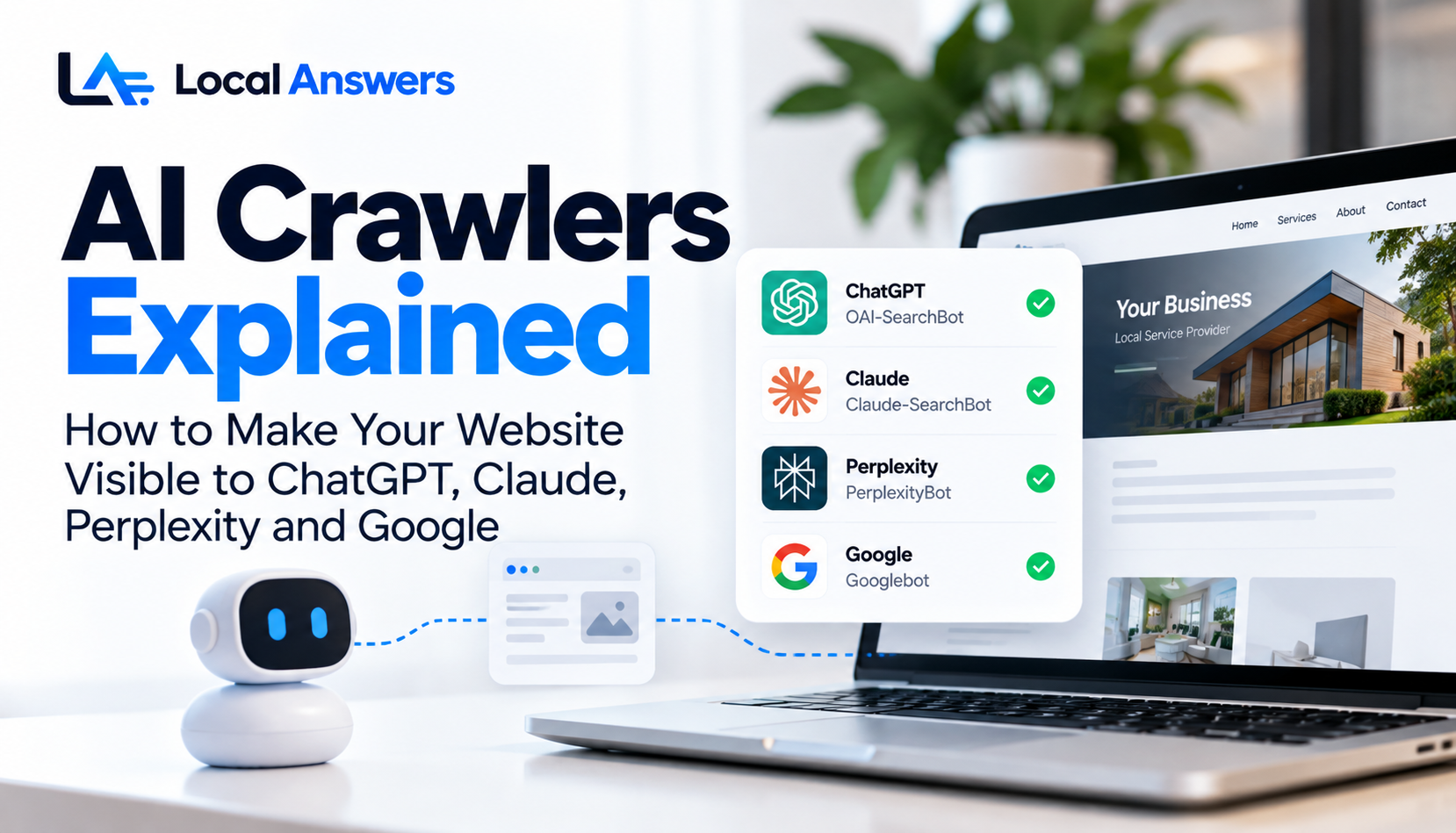
Your business has a website, detailed service pages, and an established reputation. But when someone asks ChatGPT, Claude, Perplexity, or Google AI to recommend a local provider, your company may be missing.
One possible reason is technical: the systems retrieving information for AI-powered search may not be able to access important pages on your website. That is not the only reason a business may be omitted, and allowing crawler access does not guarantee a recommendation. But access is a sensible place to investigate before investing in additional content.
For a roofer in Cumming, Georgia, the affected page might be roof replacement. For an HVAC contractor in Alpharetta, it could be heat-pump installation. For a cosmetic dentist in Johns Creek, it might be a treatment page or provider biography.
An AI crawler audit checks whether the public pages you want customers and search systems to discover are accessible to relevant search crawlers and user-directed retrieval tools.
What Is an AI Crawler Audit?
An AI crawler audit is a technical review of how automated web agents can discover and retrieve a website's public content. It examines crawler instructions, indexing eligibility, website security rules, server responses, page accessibility, and internal links.
It is one component of Generative Engine Optimization (GEO) and broader AI visibility. It should not be confused with a recommendation audit, which tests whether an AI assistant actually names or recommends the business for relevant customer questions.
A crawler audit can identify an access problem. It cannot establish that the access problem caused every missing AI recommendation.
Why Different AI Crawlers Matter
Not every bot labeled “AI” does the same job. Some gather information for model development; others discover pages for search; still others fetch a webpage because a user requested it.
That distinction gives website owners more meaningful choices. A business may wish to make its public service pages available for search while restricting some model-training collection. The correct configuration depends on its goals and each provider's current documentation.
| Platform | Agent | Documented role |
|---|---|---|
| OpenAI | OAI-SearchBot | Search-related discovery for ChatGPT Search |
| OpenAI | GPTBot | Potential model-training collection |
| OpenAI | ChatGPT-User | User-directed webpage retrieval |
| Anthropic | Claude-SearchBot | Claude search discovery |
| Anthropic | Claude-User | User-directed webpage retrieval |
| Anthropic | ClaudeBot | Model-development crawling |
| Perplexity | PerplexityBot | Search discovery and linking |
| Perplexity | Perplexity-User | User-directed retrieval |
| Googlebot | Conventional Search crawling and indexing, foundational to Google AI Search eligibility |
Agent behavior and product features can change. Confirm details in official documentation before changing crawler policies.
ChatGPT: Understand OpenAI's Different Web Agents
OAI-SearchBot
OAI-SearchBot is OpenAI's search-related crawler. Website owners who want their public pages discoverable through ChatGPT Search should check whether they have unintentionally blocked it.
For example, an electrician's EV charger installation page may be accessible to ordinary visitors but restricted by a broad robots.txt rule. That restriction deserves investigation if the business wants search-backed discovery.
GPTBot
GPTBot is associated with collection that may be used to develop OpenAI models. It is distinct from OAI-SearchBot. Allowing GPTBot is not a universal prerequisite for ChatGPT Search visibility.
ChatGPT-User
ChatGPT-User can retrieve a webpage in response to a user action or request. User-directed retrieval is distinct from ordinary search crawling, and website owners should consult OpenAI's current guidance for how their access rules apply.
Do not treat all three agents as interchangeable. A blanket rule for every AI bot may not reflect the website owner's intended balance between search discovery and model-development access.
Official reference: OpenAI crawler documentation.
Claude: Understanding Anthropic's AI Crawlers
Anthropic documents several web agents with different purposes.
Claude-SearchBot
Claude-SearchBot supports search discovery for Claude. Restricting it may reduce the availability or accuracy of website information in Claude's search-supported experiences.
For a local business, review whether important public service pages are accessible rather than assuming a general homepage crawl is sufficient.
Claude-User
Claude-User retrieves website content in response to user requests. If access is restricted, Claude may be unable to retrieve a relevant public page during a user-directed interaction.
ClaudeBot
ClaudeBot is associated with Anthropic's model-development crawling. That is a different function from search discovery or user-directed retrieval.
Allowing ClaudeBot is not necessarily required to make public pages available through Claude's search-related systems. Website owners can make separate decisions based on their preferences and Anthropic's documented controls.
Official reference: Anthropic crawler information.
Perplexity: Search Discovery and User-Directed Retrieval
PerplexityBot
PerplexityBot is used to discover and link website information in Perplexity search experiences. Businesses seeking public search discovery should review whether it can reach their important pages.
Perplexity-User
Perplexity-User retrieves pages in response to user requests. Perplexity states that user-directed retrieval can behave differently from ordinary crawling with respect to robots.txt.
Robots.txt is not a security boundary. Protect private information with authentication and access controls, not only crawler instructions.
Official reference: Perplexity crawler documentation.
Google: Googlebot and AI Search Eligibility
Google AI Overviews and AI Mode build on Google's existing Search systems. Googlebot crawling, indexing, and snippet eligibility remain important for a webpage to be eligible as a supporting link.
Google does not require a special AI-specific schema type or an llms.txt file for inclusion in AI Overviews or AI Mode. Correct conventional SEO problems before investing in speculative AI-only changes.
Official reference: Google Search Central: AI features and your website.
How to Perform an AI Crawler Audit
Step 1: Identify Your Most Important Public Pages
Start with pages connected to actual customer demand. A roofing company may prioritize roof replacement; an HVAC contractor, heat-pump installation; a dental practice, procedure pages and provider biographies. Record each canonical URL.
Step 2: Review Robots.txt
Check https://yourdomain.com/robots.txt for rules affecting the crawlers you intend to allow. A broad Disallow: / rule can block compliant crawlers from the entire site. Review the full set of matching directives before changing anything.
The following is an illustrative robots.txt configuration, not a universal recommendation:
User-agent: OAI-SearchBot
Allow: /

User-agent: Claude-SearchBot
Allow: /

User-agent: PerplexityBot
Allow: /
Actual access also depends on other matching rules, site configuration, and each provider's documented behavior. Do not paste example directives without reviewing the existing file and your organization's preferences.
Step 3: Check Indexing and Canonicals
Use Google Search Console to inspect important URLs. Look for unintended noindex directives, incorrect canonical tags, redirects, and server errors. A page that is inaccessible or excluded from indexing may not qualify for Google's AI Search supporting links.
Step 4: Check Security and Firewall Rules
Cloudflare, AWS WAF, hosting firewalls, and bot-management products can block automated requests even when robots.txt allows them. Review server or security logs, current verified crawler information, and applicable access rules. Do not turn off necessary protections indiscriminately.
Step 5: Verify Page Content Is Readable
Ensure that business descriptions, services, location information, and key links appear in accessible page content. Test important pages without relying on unusual interactive controls or login-only interfaces.
Step 6: Review Internal Linking and the Sitemap
Important pages should be reachable through useful navigation and contextual links. A sitemap can help expose canonical URLs, but it does not replace a navigable website or guarantee indexing.
Step 7: Record Evidence and Prioritize Fixes
| Audit finding | Action | Suggested priority |
|---|---|---|
| Important public page blocked by unintended crawler rule | Review and correct access policy | High |
| Critical service page excluded from Google indexing | Investigate exclusion and canonical signals | High |
| Firewall challenges verified search crawlers | Review targeted security rules | High |
| Essential content unavailable in readable page text | Improve accessibility | High |
| Broken internal links to core services | Repair navigation | Medium |
| Inaccurate structured business information | Correct visible facts and markup | Medium |
| Missing canonical URL from sitemap | Update sitemap where appropriate | Medium |
These priorities reflect practical troubleshooting, not secret AI ranking weights.
Common AI Crawler Audit Mistakes
Blocking Every AI Bot Without Distinguishing Its Purpose
This may be a deliberate policy, but owners should understand the difference between model-development crawling and search retrieval before making the decision.
Assuming Access Guarantees a Recommendation
An accessible page can still be omitted. Business relevance, the user's question, geography, available sources, and platform behavior also matter.
Treating Robots.txt as a Privacy Tool
Robots.txt is public guidance for compliant crawlers. Confidential records and customer portals require real security controls.
Chasing AI-Only Files While Ignoring Indexing Problems
Fix broken links, indexing exclusions, and inaccessible service information first. Google does not require llms.txt for its AI Search experiences.
A Practical 14-Day AI Crawler Audit Plan
Days 1–3: Establish the Technical Baseline
List important public pages, inspect Google Search Console, review robots.txt, and document current crawler preferences.
Days 4–6: Investigate Search-Related Access
Review OAI-SearchBot, Claude-SearchBot, Claude-User, PerplexityBot, and other relevant retrieval behavior. Examine security logs for evidence of blocked requests.
Days 7–10: Correct Verified Problems
Address unintended restrictions, indexing issues, broken internal links, and inaccessible service content. Preserve protections for private information.
Days 11–14: Validate and Plan Monitoring
Recheck corrected URLs, record remaining issues, and assign ownership for future audits after migrations or security changes.
Fourteen days is an implementation framework, not a promise that every system will immediately retrieve or recommend updated pages.
Frequently Asked Questions
What is an AI crawler audit?
An AI crawler audit reviews whether search-related AI agents can access important public website content. It includes robots.txt, indexing, server responses, security controls, page accessibility, and internal linking.
Does ChatGPT crawl websites?
OpenAI documents different agents, including OAI-SearchBot for search-related discovery, GPTBot for potential model-development collection, and ChatGPT-User for user-directed retrieval.
What is Claude-SearchBot?
Claude-SearchBot is Anthropic's crawler associated with search discovery. Restricting it may limit the availability of a site's information in Claude search experiences.
Do I need to allow ClaudeBot for Claude search visibility?
Not necessarily. ClaudeBot has a different purpose from Claude-SearchBot and Claude-User. Consult Anthropic's current documentation before choosing crawler policies.
What is PerplexityBot?
PerplexityBot is Perplexity's search discovery crawler. It is distinct from Perplexity-User, which handles user-directed retrieval.
Does Google need special AI crawler access?
Google's AI Overviews and AI Mode rely on established Google Search systems. Ordinary crawlability, indexing, and snippet eligibility remain important.
Is robots.txt enough to protect private content?
No. Use authentication and appropriate security controls for private or confidential information.
Does allowing AI crawlers guarantee recommendations?
No. Access is one possible prerequisite for retrieval, not a guaranteed placement mechanism.
Is special schema required for AI search?
Google does not require AI-specific schema for AI Overviews or AI Mode. Accurate conventional structured data can still support applicable search features.
Should local businesses use llms.txt?
Google does not require it for AI Search. Prioritize verified accessibility, indexing, and content issues first.
How often should businesses audit crawler access?
Review it after website migrations, major security changes, robots.txt updates, and periodically as part of technical SEO maintenance.
Can an AI Visibility Audit identify crawler problems?
Yes. A comprehensive assessment can investigate crawler access alongside business recommendations, citations, competitor appearances, and public information accuracy.
Your Website Cannot Be Retrieved by a Search System That Cannot Access It
Local businesses invest in service pages, professional biographies, project examples, and educational resources. Those investments may have limited value in search-backed experiences when important public pages are inaccessible.
An HVAC company may have a useful heat-pump page blocked by a firewall. A roofing contractor may have a project guide excluded from indexing. A professional practice may publish provider information that is difficult for retrieval systems to read.
These are technical problems worth fixing. But they are not the entire AI visibility strategy.
The goal is not simply to allow more bots onto your website. It is to make accurate, useful public information accessible to the search systems you choose to participate in—and then measure whether your business actually appears in relevant recommendations.
Find Out Whether AI Can Discover and Recommend Your Business
When someone asks ChatGPT for businesses in your industry, does your company appear? Can Claude retrieve your important service pages? Does Perplexity cite your website or competing sources? Are your pages eligible for Google's AI-powered Search experiences?
The LocalAnswers AI Visibility Audit helps investigate these questions. We evaluate relevant customer searches across leading AI platforms, identify competitors receiving recommendations, and examine meaningful gaps in public information, technical accessibility, indexing, and service content.
The findings become a prioritized improvement roadmap based on observed evidence rather than guaranteed AI placement claims.
Get Your LocalAnswers AI Visibility Audit
Discover whether AI can access your website, whether your business appears in recommendations, and what to improve first.
Request Your LocalAnswers AI Visibility Audit
Become the business AI recommends.