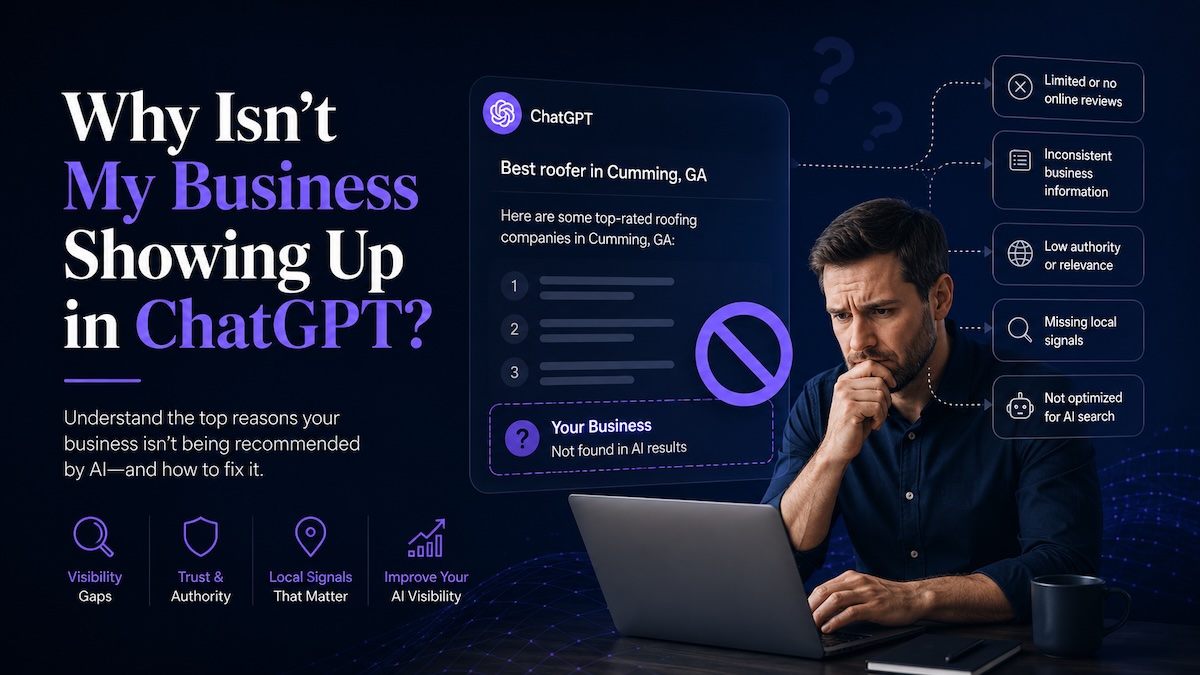
You ask ChatGPT to recommend the best roofer in your area. Your competitor's name comes back. Yours doesn't.
You try again. "Best HVAC company in Cumming, Georgia." Same result. The AI confidently names three businesses, and somehow you're still invisible.
If you have spent any time around digital marketing, this feels familiar and unfair in a new way. You rank on page one of Google. You have hundreds of five-star reviews. You have been in business for fifteen years. But when a homeowner asks an AI assistant for a recommendation, you might as well not exist.
This guide explains, in plain language, why that happens and what you can actually do about it. It draws on what OpenAI and Google have publicly disclosed, what the AI search industry has observed since generative search went mainstream, and what we have seen working for real local businesses across the United States.
There are no shortcuts here. There is no "ChatGPT submission form." There is no magic schema tag that puts you on top. But there is a clear set of signals that AI models use to decide which businesses to trust, and you can influence almost every one of them.
Let's get into it.
Why This Question Matters More Every Month
Consumer behavior has shifted faster than most local business owners realize.
A few years ago, a homeowner with a leaking roof would type "best roofer near me" into Google, scan the map pack, click two or three websites, and pick one. Today, a growing share of those same homeowners open ChatGPT, Claude, Gemini, Perplexity, or Grok and ask a conversational question instead.
The phrasing has changed too. People no longer just search for keywords. They ask questions like:
- "Who's the most trusted roofer in Forsyth County?"
- "What's a reliable family dentist near me that takes Aetna?"
- "I need an HVAC company in Cumming that's good with older homes. Any recommendations?"
The AI answers with a short list, often three to five businesses, sometimes with a sentence of justification for each one. The user clicks one. The other businesses in town are not just lower on the page. They are not on the page at all.
This is a fundamental change in how recommendations work. Traditional search showed ten blue links and let the user choose. AI search makes the choice first and presents it as an answer.
For local businesses, the practical question is no longer "where do I rank on Google?" It is "am I one of the three businesses the AI mentions, or am I one of the dozens it ignores?"
If you're reading this, you already know which side you're on. Now let's understand why.
How ChatGPT Actually Finds Businesses
Before diagnosing why your business is missing, it helps to understand how AI tools build their recommendations in the first place. For an in-depth look at how ChatGPT specifically processes these signals for Forsyth County businesses, see our earlier post on how ChatGPT decides which local businesses to recommend.
A few important caveats up front. No one outside OpenAI, Google, Anthropic, xAI, or Perplexity knows the exact internal logic these models use. Anyone who tells you they have cracked the algorithm is either guessing or selling you something. What we do know comes from public statements, observable behavior, and consistent patterns across thousands of test queries.
With that said, here is a reasonable working model of how AI tools surface local businesses. The same signals apply whether you run a roofing company, a chiropractic practice, an HVAC business, a dental office, a med spa, a law firm, or a physical therapy clinic.
1. Training Data
Large language models are trained on enormous amounts of publicly available text from the web. This includes business websites, news articles, blog posts, review sites, directories, forums, and social platforms. If your business is mentioned consistently across trusted sources, the model has likely encountered your name many times during training and associates it with your industry and location.
2. Real-Time Retrieval
Most modern AI assistants do not rely on training data alone for local recommendations. They use real-time search retrieval to pull current information from the web before composing an answer. ChatGPT uses Bing under the hood for much of its web search. Google's AI Overviews use Google Search. Perplexity uses its own index. Claude has search built in as well.
This means the search engine results behind the scenes still matter enormously. If you don't rank well in Bing or Google for the underlying query, you are unlikely to be retrieved into the AI's context window in the first place.
3. Trusted Source Recognition
AI models tend to weight certain sources more heavily than others. Established review platforms, established news sites, Better Business Bureau listings, established directories, and government databases are treated as more authoritative than unknown blogs or self-published content. When your business is mentioned on those trusted sources, it carries more weight than the same mention on a low-quality site.
4. Entity Recognition
AI models work with "entities," which is a fancy word for distinct things in the world. Your business is an entity. Your location is an entity. Your service categories are entities. The model is constantly trying to connect entities together. If your business name consistently appears next to your service category, your city, and positive descriptors, the model learns to associate you with that combination.
5. Consistency Across the Web
Models notice when information about a business is consistent everywhere it appears and they notice when it isn't. Different addresses, different phone numbers, different business names, conflicting hours, and outdated information all weaken the model's confidence that it knows who you are.
6. Sentiment and Review Signals
Reviews carry weight not just as star ratings but as text. Models read review content and extract sentiment, common themes, and specific praise or complaints. A business with hundreds of detailed positive reviews mentioning specific service categories has a richer signal than one with the same star rating but generic comments.
7. Local Relevance
When someone asks for a recommendation in a specific area, the model tries to match businesses to that area. This is part Google Business Profile data, part address mentions across the web, part service area content on the business's website, and part contextual cues like local news mentions and community involvement.
The key insight is that there is no single ranking factor and no central submission process. AI visibility is the cumulative result of dozens of signals across the web, and the businesses that win are not the ones with the cleverest tricks. They are the ones with the deepest, most consistent, most trustworthy digital footprint.
17 Reasons Your Business Isn't Showing Up in ChatGPT
Here are the most common reasons local businesses fail to appear in AI recommendations. Most businesses suffer from several of these at once. Work through them honestly.
1. Weak Online Authority
Why it matters: Authority is the foundation of AI trust. If your business is not referenced by other established sources, the model has no reason to be confident in recommending you.
How to identify it: Search your business name in quotes on Google and Bing. Count how many results are not controlled by you (your own website, your own social profiles, your own directory submissions). Independent mentions are what matter.
How to improve it: Pursue guest articles, local news coverage, podcast appearances, association memberships, awards, and partnerships. Authority is built slowly through real participation in your industry and community.
2. Poor Review Profile
Why it matters: Reviews are one of the most consistent signals across AI tools. Volume, recency, average rating, response rate, and review text all factor in. Our Forsyth County Roofing AI Visibility Report found that of 54 companies analyzed, the 15 that received AI recommendations had significantly stronger review profiles than the 39 that received none.
How to identify it: Compare your review count and average rating to the top three competitors in your city on Google, Yelp, BBB, and any industry-specific platforms (Healthgrades, Avvo, Houzz, etc.).
How to improve it: Build a consistent review request process into your customer experience. Aim for steady volume rather than a sudden burst. Respond to every review, positive and negative, in a professional tone.
3. Inconsistent Business Information (NAP)
Why it matters: Name, Address, and Phone number consistency across the web is one of the oldest local SEO signals and it still matters for AI. Inconsistencies confuse models and reduce confidence. The same Forsyth County roofing research consistently found NAP inconsistency among the companies that received zero AI recommendations.
How to identify it: Audit your listings on Google Business Profile, Bing Places, Apple Maps, Yelp, Facebook, BBB, Yellow Pages, and your top ten industry directories. Note any variations.
How to improve it: Standardize one exact version of your business name, address, and phone number. Update every listing to match. Use a citation management tool if needed.
4. Weak or Missing Google Business Profile
Why it matters: Google Business Profile is one of the highest-trust sources for local business information. AI tools that use Google's index pull heavily from it.
How to identify it: Search your business name on Google. If no Knowledge Panel appears on the right side of the results, or if the panel has missing photos, hours, or service categories, you have a problem.
How to improve it: Claim and fully complete your profile. Add categories, services, hours, attributes, photos, and a thorough business description. Post updates regularly. Our AI visibility checklist walks through the complete Google Business Profile setup step by step.
5. Missing or Broken Structured Data
Why it matters: Structured data (schema markup) tells search engines and AI crawlers what your content is about in machine-readable form. It does not guarantee inclusion but it makes inclusion easier.
How to identify it: Run your homepage and key service pages through Google's Rich Results Test. Look for LocalBusiness, Service, FAQPage, and Review schema. Note any errors.
How to improve it: Implement LocalBusiness schema on your homepage, Service schema on each service page, and FAQPage schema where appropriate. Validate everything. Fix errors.
6. Few Independent Mentions
Why it matters: Self-published content is necessary but not sufficient. AI models look for third-party validation that your business exists, operates in your stated area, and provides the services you claim.
How to identify it: Search your business name with no quotes. Count the number of distinct domains that mention you. If almost all results come from your own site or your own social profiles, you have a thin footprint.
How to improve it: Get listed in industry associations, chamber of commerce directories, local news features, community sponsorship pages, and supplier or partner websites.
7. Thin Website Content
Why it matters: Your website is the first place AI tools verify what you do and where you do it. Sparse content gives the model very little to work with.
How to identify it: Look at your service pages. If they are under 300 words, full of stock language, or indistinguishable from a hundred other businesses, they are thin.
How to improve it: Write detailed, specific service pages that explain what you offer, who you serve, where you serve them, and what makes your work different. Aim for depth, not word count for its own sake.
8. Little Topical Authority
Why it matters: AI tools recognize businesses that demonstrate genuine expertise in their field, not just businesses that say they have expertise.
How to identify it: Look at your blog or resource section. If it is empty, outdated, or full of generic posts, you have no topical authority to speak of.
How to improve it: Publish substantive content that answers real customer questions in your industry. Roofers should write about specific roofing problems. Dentists should write about specific procedures. Depth beats frequency.
9. No Location-Specific Content
Why it matters: AI tools matching businesses to a specific area need content that ties you to that area. A generic site that never mentions your city sends a weak local signal.
How to identify it: Search your own site for your primary city and neighboring cities. If there are very few mentions, you have a gap.
How to improve it: Create location pages for the cities and neighborhoods you serve. Mention local landmarks, communities, and specifics that demonstrate actual presence in the area. Avoid the spammy "city + service" template that floods every page with the same content.
10. Weak Backlink Profile
Why it matters: Backlinks remain a strong signal of authority. They influence how Google ranks you, which influences which businesses are retrieved when AI tools search the web.
How to identify it: Use a free tool like Ahrefs Webmaster Tools or Ubersuggest to see your backlink count and referring domains. Compare to competitors.
How to improve it: Earn links through genuine PR, partnerships, guest content, sponsorships, and resources worth linking to. Avoid paid link schemes.
11. No Media Mentions
Why it matters: Local news, trade publications, and industry blogs are highly trusted sources. Being quoted, profiled, or featured by them dramatically improves AI confidence.
How to identify it: Search your business name on news.google.com. If there are zero or near-zero results, you have a media gap.
How to improve it: Pitch local reporters on stories tied to your expertise. Respond to HARO or Qwoted queries. Join industry associations that issue press releases.
12. Limited Industry Citations
Why it matters: Industry-specific directories carry more weight in their vertical than general directories. A plumber listed on plumbing-specific platforms looks more legitimate than one listed only on Yelp.
How to identify it: Make a list of the top five to ten directories in your specific industry. Check which ones list you.
How to improve it: Get listed everywhere relevant in your vertical. Healthcare has its directories. Law has its directories. Home services have theirs. Find yours and claim every spot.
13. Poor Reputation Signals
Why it matters: Reputation is more than star ratings. Patterns of complaints, BBB ratings, unresolved disputes, and negative news all factor into how AI tools evaluate trust.
How to identify it: Search your business name plus "complaints," "scam," "lawsuit," and "review." Note anything that comes up.
How to improve it: Respond to and resolve outstanding complaints. Address BBB issues. Build a deep base of recent positive reviews to dilute older negatives.
14. Outdated Website
Why it matters: An outdated website signals an outdated business. Slow load times, broken pages, expired copyright notices, and obsolete information all reduce trust.
How to identify it: Run your site through Google PageSpeed Insights and look for any indicators of staleness on your homepage and contact page.
How to improve it: Refresh your design, fix technical issues, update your copyright year, refresh stale content, and make sure every service you currently offer is reflected on the site.
15. Lack of Trust Indicators
Why it matters: Licenses, certifications, insurance, accreditations, awards, and association memberships all serve as trust signals to AI tools just as they do to customers.
How to identify it: Look at your homepage and footer. Are your credentials clearly displayed? Are they verifiable?
How to improve it: Add a trust block to your site that displays licenses, certifications, BBB rating, awards, and association memberships. Link to the verifying body where possible.
16. Minimal Local Authority
Why it matters: Beyond general authority, AI tools weigh whether you are actually established in the specific area you claim to serve.
How to identify it: Search your city plus your service category on Google. Are you mentioned in local resources, community pages, sponsor lists, and event coverage? Or are you absent?
How to improve it: Sponsor local events, join the chamber of commerce, partner with other local businesses, and create content tied to local concerns. Local presence is earned by showing up.
17. Stronger Competitors
Why it matters: Sometimes the answer is uncomfortable. Your competitors are doing more, better, longer. They have more reviews, deeper content, more authority, and broader citations. The model is not ignoring you. It is choosing them.
How to identify it: Pick the three businesses ChatGPT recommends in your category and city. Audit each one across the sixteen factors above. Compare honestly.
How to improve it: This is the long game. Identify where the gap is biggest and start closing it. There is no shortcut, but the work compounds.
Not sure which of these is hurting you most?
Our AI Visibility Audit identifies your specific gaps in 24–48 hours and gives you a prioritized action plan for your exact market.
Get Your AI Visibility AuditCommon Myths About AI Visibility
Most of what's circulating online about ChatGPT optimization is wrong, oversimplified, or actively counterproductive. Here are the most damaging myths and the truth behind each one.
Myth 1: "You can stuff ChatGPT keywords into your site to rank."
There is no special set of "ChatGPT keywords." Language models are trained on natural language and pull from a broad understanding of meaning, not exact-match strings. Stuffing your site with phrases like "ChatGPT recommended" or "AI-trusted" will not help you and may hurt your traditional SEO.
What works instead is writing clearly and specifically about what you do, for whom, and where.
Myth 2: "You can submit your website to ChatGPT."
There is no submission form. OpenAI does not maintain a directory you can apply to. The way to get into ChatGPT's context is to be referenced across the open web in ways the model can find through training or real-time retrieval.
The closest equivalent to a "submission" is making sure your site is crawlable, your structured data is clean, and your business is consistently represented on the directories and platforms that AI tools draw from.
Myth 3: "Buying backlinks will get you recommended by AI."
Paid links have been a black-hat SEO tactic for years and the risk-reward has only gotten worse with AI. AI tools weight source quality heavily, and link networks that exist to sell placements tend to be low-quality sources that contribute little to genuine authority.
Worse, Google actively penalizes link schemes, and a penalty in Google search translates into reduced visibility for the AI tools that rely on Google's index.
Myth 4: "AI ignores SEO. It's a totally separate game."
This is half-right and very misleading. AI tools do not use SEO in the narrow sense of optimizing for specific keyword rankings. But almost every AI tool that surfaces local businesses relies on traditional search retrieval to find candidates. If you cannot be found through search, you cannot be retrieved into the AI's answer.
SEO is not obsolete. It is necessary but no longer sufficient. For a full breakdown of how GEO and AEO relate to traditional SEO, see our guide to GEO, AEO, and local AI visibility.
Myth 5: "Only Google rankings matter."
Google rankings matter a lot. But Bing matters more than most business owners realize because ChatGPT's web search uses Bing. Perplexity has its own index. Yelp, BBB, industry directories, and review platforms feed into recommendations independently of Google.
A balanced presence across the platforms that matter to your industry is more durable than a heavy focus on Google alone.
Myth 6: "If I just publish more content, I'll show up eventually."
Volume without substance is invisible. Publishing thirty thin blog posts written to hit keywords will not improve your authority. Publishing five genuinely useful resources that answer real customer questions will.
The content that wins in AI search is content a real human expert would actually write.
Myth 7: "AI visibility is purely about reviews."
Reviews matter, but they are one signal among many. A business with great reviews and almost no other digital presence can still be invisible to AI. A business with moderate reviews but strong authority, citations, and content can be recommended consistently.
Treat reviews as one leg of the stool, not the whole thing.
The Practical AI Visibility Checklist
Work through this systematically. For a focused version covering just this month's highest-impact priorities, see our AI visibility checklist for local businesses. The comprehensive version covering all fifty items follows.
Business Information Foundation
- Single, standardized version of your business name, address, and phone number documented internally
- Google Business Profile claimed and fully completed
- Bing Places listing claimed and verified
- Apple Business Connect listing claimed
- Yelp listing claimed and accurate
- Facebook Business Page complete with current information
- NAP consistent across the top twenty directories in your industry
- Business hours updated everywhere, including holiday hours
- Service categories accurate and consistent across platforms
- Business description rewritten to be specific rather than generic
Website Foundation
- Mobile responsive design that loads in under three seconds
- SSL certificate active across all pages
- Clear contact information on every page
- About page that explains who you are, your history, and your credentials
- Service pages with at least 600 words of specific, original content each
- Location pages for each city or neighborhood you serve
- Privacy Policy and Terms of Service published
- Sitemap submitted to Google Search Console and Bing Webmaster Tools
- Robots.txt that allows AI crawlers (GPTBot, ClaudeBot, PerplexityBot, Google-Extended)
- Schema markup implemented and validated for LocalBusiness, Service, and FAQPage
Content Authority
- Blog or resource section actively publishing at least monthly
- At least ten cornerstone articles answering common customer questions
- Content that mentions local landmarks, communities, and regional specifics
- Case studies or project galleries demonstrating actual work
- Frequently Asked Questions page with detailed answers
- Glossary or learning hub for industry-specific terms
- Original images of your team, location, and work
- Author bios on content where appropriate to establish expertise
Reviews and Reputation
- Active review request process built into customer workflow
- Steady review volume across Google, Bing, Yelp, and industry platforms
- Every review responded to professionally
- Negative reviews addressed and resolved where possible
- BBB accreditation pursued if appropriate for your industry
- Reviews referenced (with permission) in case studies and testimonials on your site
- Industry-specific review platforms claimed and monitored
Authority Building
- Listed in chamber of commerce or local business directory
- Member of relevant industry associations with public-facing listing
- Local news coverage pursued at least quarterly
- Guest articles or contributed expertise on at least three external publications per year
- Sponsorships of local events, teams, or charities with public acknowledgment
- Partnerships with complementary businesses that include link or mention exchanges
- Awards and recognitions pursued and displayed
- Licenses and certifications prominently displayed with verifiable credentials
Technical AI Readiness
- AI crawlers explicitly allowed in robots.txt
- Structured data validated through Google Rich Results Test
- Open Graph and Twitter Card metadata complete
- Knowledge Graph eligibility pursued through consistent entity signals
- Wikipedia or Wikidata presence where appropriate and earned
- YouTube or video presence where relevant to your industry
- Regular monitoring of AI search results for your business and competitors
What the Research Shows: A Forsyth County Roofing Case Study
We don't have to speculate about how these signals play out in the real world. Our Forsyth County Roofing AI Visibility Report analyzed 54 roofing companies in Cumming and the surrounding area and tested each one across ChatGPT, Gemini, Claude, Perplexity, and Grok.
The findings were stark. Of 54 companies analyzed, only 15 received any AI recommendation at all. That's a 28% visibility rate — meaning 72% of roofing businesses in Forsyth County are effectively invisible to AI platforms regardless of how long they've been in business or how well they rank on Google.
More revealing: recommendations were not distributed evenly across those 15. Three companies dominated the recommendations, appearing across multiple platforms and multiple query types. The remaining 12 received occasional, inconsistent mentions. The other 39 received zero.
What separated the three dominant businesses from the invisible ones was not marketing spend or years in business. It was signal depth: deeper review profiles, more consistent business information across the web, stronger citation footprints, and more content on their websites that clearly answered who they are, what they do, and where they serve.
The same pattern holds in every market we've studied. AI recommendations don't reward the most established business. They reward the most verifiable one.
Frequently Asked Questions
How long does it take to start showing up in ChatGPT?
There is no fixed timeline. Businesses that already have strong digital foundations may see improvement within weeks of focused work. Businesses starting from scratch typically need six to twelve months of consistent effort across reviews, content, citations, and authority building before they begin appearing reliably in AI recommendations.
Can I pay OpenAI to be recommended?
No. OpenAI does not sell placement in ChatGPT recommendations. Any service claiming to guarantee placement through payment to OpenAI is misrepresenting how the system works.
Does ChatGPT use Google to find businesses?
ChatGPT primarily uses Bing for real-time web search. However, Bing and Google index largely overlapping sets of websites, and the same signals that make you visible in one tend to help in the other. Strong performance in Google search usually correlates with strong performance in Bing as well.
What is GEO and how is it different from SEO?
GEO stands for Generative Engine Optimization. It refers to the practice of optimizing for AI search engines specifically. In practice, GEO overlaps heavily with traditional SEO but emphasizes entity recognition, structured data, authoritative citations, and content that answers questions in the way conversational AI tools retrieve information. It is best understood as an evolution of SEO rather than a replacement for it.
Will blocking AI crawlers help or hurt my business?
For most local businesses, blocking AI crawlers hurts you. If you block GPTBot, ClaudeBot, PerplexityBot, or Google-Extended in your robots.txt, you are telling those tools they cannot read your site. They will then rely on third-party information about your business rather than your own preferred messaging. Allow these crawlers unless you have a specific reason not to.
Do reviews on Yelp matter for ChatGPT?
Yes. AI tools draw from many review sources, and Yelp remains a frequently cited source for local business information. Strong Yelp presence contributes to overall reputation signals even if Google reviews carry more weight in many categories.
Should I create separate pages for every city I serve?
If you genuinely serve those cities and can write meaningful, original content about your work in each one, yes. If you would just be copying the same content with the city name swapped, no. Thin, templated location pages can hurt more than they help.
Does the age of my domain matter for AI search?
It is a small factor among many. An older domain with consistent history is generally trusted more than a brand new one, but a new domain that builds the right signals quickly can outperform an older domain that has been neglected.
Can negative reviews keep me out of ChatGPT recommendations?
A small number of negative reviews within a generally positive profile will not block you. A pattern of recent unresolved complaints, BBB issues, or news coverage of disputes can significantly reduce AI confidence in recommending you. The shape of your reputation matters more than any single review.
Does ChatGPT see my Google Business Profile directly?
Not directly. ChatGPT does not have a special connection to Google. However, your Google Business Profile information often appears in search results, Knowledge Panels, and aggregator sites that AI tools do retrieve. A strong Google Business Profile indirectly improves your AI visibility through these downstream effects.
How important is having a Wikipedia page?
Wikipedia presence is a strong trust signal but is appropriate only for businesses that meet Wikipedia's notability standards. Attempting to create a Wikipedia page for a small local business that does not meet those standards will result in deletion and can backfire. For most local businesses, Wikidata listings are a more realistic alternative.
What's the most important single thing I can do?
If you can only do one thing, build a complete, accurate, frequently updated Google Business Profile and consistently earn detailed positive reviews. These two foundations underpin most AI visibility for local businesses. Everything else amplifies these signals.
How often should I check my AI search results?
Monthly at minimum. Quarterly at a strategic level. Test the same set of queries across ChatGPT, Claude, Gemini, Perplexity, and Google AI Overviews. Track which businesses appear, how the responses change, and whether your presence improves over time.
Does video content help with AI visibility?
It can. YouTube is part of Google's ecosystem and content on YouTube is sometimes referenced by AI tools. More importantly, video transcripts and descriptions provide additional indexable content that can reinforce your entity and authority signals.
Should I worry about AI hallucinating false information about my business?
Yes, and the best defense is a strong, consistent digital footprint. When AI tools have abundant accurate information about your business, they are less likely to fabricate details. When information about your business is scarce or inconsistent, hallucination risk increases.
Are AI recommendations the same across all users?
No. AI tools personalize results based on conversation context, user history (in some cases), and location signals. Two users asking the same question in different cities will get different recommendations. Two users in the same city may get slightly different framing depending on the rest of their conversation.
Can social media help with AI visibility?
Indirectly. Social profiles serve as additional citations of your business name, location, and category, which reinforces entity recognition. Active social presence also signals an operating business. But social content itself is rarely retrieved into AI answers for local recommendations.
What about ChatGPT plugins or custom GPTs?
Custom GPTs and plugins are different from the core ChatGPT recommendation behavior most users experience. Building a custom GPT for your business does not make your business more likely to be recommended when other users ask general questions in the standard ChatGPT interface.
How do I know if my structured data is actually working?
Use Google's Rich Results Test and Schema Markup Validator to confirm your structured data is valid. Beyond validation, monitor whether your Google Business Profile shows enhanced features in search results and whether Knowledge Panels appear for your business. These are downstream indicators that structured data signals are being received.
Is AI visibility something I can do myself, or do I need help?
Many of the foundational steps can be done in-house if you have the time and discipline to work through them systematically. Structured data implementation, content strategy, authority building, and ongoing monitoring often benefit from specialized help, particularly for businesses where AI visibility represents real revenue at stake.
Key Takeaways
AI tools do not have a submission form, a paid placement program, or a secret algorithm. They build recommendations from the cumulative digital footprint of every business they encounter, weighted by trust, consistency, authority, and relevance.
You cannot trick your way into AI visibility. Keyword stuffing, paid links, fake reviews, and templated content do not work and often backfire.
You can earn AI visibility through real work. Strong reviews. Complete and consistent business listings. Substantive content. Genuine local presence. Verifiable credentials. Third-party validation from trusted sources.
The businesses being recommended by ChatGPT, Claude, Gemini, Perplexity, and Google AI Overviews are the same businesses that would have earned word-of-mouth recommendations in their community over the past thirty years. The technology has changed. The fundamentals have not.
If your business is invisible in AI search today, the path forward is clear. Audit honestly against the seventeen factors. Work through the checklist. Build the signals that matter. Give it time. The compounding effect of consistent, trustworthy digital presence is the closest thing to a competitive moat that exists in local business in 2026.
You do not need to be the loudest. You need to be the most trusted.